Renting in Vancouver
Pet-Friendly Rentals in Metro Vancouver
BC gives a tenant no right to keep a pet, and most apartments here sit under a strata bylaw as well as a lease. Where the one-yes stock is, and what it costs.
Updated 2026-08-12 · 54 min read
A pet damage deposit on the City of Vancouver one-bedroom asking rent is $1,188.50, and it is the least of what an animal costs you here.
Section 18(1) of the Residential Tenancy Act says a tenancy agreement may include terms prohibiting pets, or restricting the size, kind or number of pets a tenant may keep. Nothing anywhere in the Act points the other way. There is no right to keep a pet in a BC rental, no obligation on a landlord to consider one, and no remedy if they decline your application because of a cat.
So this is a supply problem before it is a legal one, and the supply problem has a specific shape. Getting an animal into a Metro Vancouver apartment can require three separate yeses from three parties who do not consult each other: your landlord, the strata corporation that owns the building's bylaws, and the municipality that licenses the animal. Your landlord controls exactly one of those. In the rented-condo and strata-townhouse half of this market the second one exists, and most renters do not find out it exists until after they have signed.
That is the argument this page is built on, and it produces one instruction that changes a search more than anything else in it: search purpose-built rental first. A purpose-built rental building has one owner and no strata, so there is no bylaw layer above the landlord and their yes is the only yes you need. It is also, by CMHC's own count, about a third of the region's rental housing — which is why the pet search feels harder than the rent alone suggests, and why the rest of this guide spends more time on building type than on breed.
What follows runs in the order a search actually runs. The gates first, and who controls each. Then the money, because the deposit rules are short and arithmetic and the place landlords most often ask for something they are not allowed to have. Then the map, which turns out to be a map of building age rather than of postcodes. Then the mechanics of the application, the tenancy and the move-out.
Rents below are CMHC's Rental Market Survey for October 2025, published 11 December 2025, and asking rents are from the Rentals.ca and Urbanation National Rent Report for July 2026. Fares are TransLink's, effective 1 July 2026. Statute is quoted from BC Laws and RTB policy guidelines from the Residential Tenancy Branch. Everything was checked on 11 August 2026.
Three permissions, and your landlord controls one of them
Three parties can withhold a yes, and two more shape what the yes is worth: the legislature above them, which decides what a landlord is allowed to do at all, and your insurer beside them, which decides what the animal costs you once it is in. Read the five in order and the sequencing problem becomes obvious.
| Gate | Who decides | What they may do | Source |
|---|---|---|---|
| The Act | The legislature | Permits a tenancy agreement to prohibit pets, or restrict their size, kind or number | RTA s. 18(1) |
| The tenancy agreement | Your landlord | Ban, permit, or permit on conditions; may take a pet damage deposit only where they permit | RTA s. 18(2), s. 20(c) |
| The strata bylaws | Owners of the building, by three-quarters vote | Ban or limit pets across the whole building; binds tenants and occupants, not only owners | SPA s. 123, s. 130 |
| The municipal bylaw | Council | Licensing, number of animals per dwelling, leash rules, dangerous-dog declarations | Local animal control bylaws |
| The insurer | Your insurer, and sometimes the landlord's | Exclude liability arising from certain breeds; the lease may require you to carry cover | Policy wording |
The Act permits the ban. The landlord decides whether to use it. The strata can override a landlord who says yes. And the municipality and the insurer both apply after you have moved in, when you have nothing left to bargain with.
The landlord gate is the one everybody expects and the least interesting, because there is no argument to be had at it. A landlord may refuse pets and need not give a reason. What matters is the wording that ends up in the written agreement, because section 18(1)(a) authorises restriction as well as prohibition. "One cat", "no dogs over 25 lb", "one animal, no dogs" and "small caged animals only" are all lawful terms, and each one is a different tenancy.
The strata gate is the expensive one, and it gets its own section below because the rules about who has to show you the bylaws are not what most renters assume.
The one place all of this stops applying is a certified guide or service dog, which is not a pet in law. Section 18(3) makes the Act's pet provisions subject to the Guide Dog and Service Dog Act, and section 3(2) of that Act prohibits denying a guide dog team, service dog team or retired team a rental unit "advertised or otherwise represented as available for occupancy by a tenant", and prohibits imposing a tenancy term that discriminates on the basis that the person intends to keep the dog. RTB Policy Guideline 31 is explicit that no pet damage deposit may be required for one. A landlord may ask to see the certification, so keep a copy with your tenancy paperwork rather than producing it as an argument later.
Emotional support animals sit outside that Act — BC certifies guide and service dogs, not comfort animals — but they are not necessarily outside the law altogether. Physical and mental disability are protected grounds in tenancy under section 10 of the BC Human Rights Code, and a refusal that ignores a genuine disability-related need can be a human rights matter rather than a tenancy one, decided by the Human Rights Tribunal on evidence about the disability and the accommodation. That is a slow route with an uncertain outcome and a one-year filing limit. It is worth knowing about. It is not a search strategy.
The bylaws are the landlord's to hand over, not yours to chase
Most apartments in this region are strata lots, and a strata bylaw prohibiting pets binds tenants and occupants rather than only owners. Your landlord can be delighted about the dog and still be unable to deliver. Section 121(1)(a) of the Strata Property Act makes a bylaw unenforceable only where it contravenes the Act, the regulations, the Human Rights Code or another enactment, and a pet ban contravenes none of them. The strata's no is the end of the conversation.
Here is the part almost nobody uses, and it reverses who has to do the work. Section 146 says that before a landlord rents all or part of a residential strata lot, the landlord must give the prospective tenant "the current bylaws and rules" and a Notice of Tenant's Responsibilities in the prescribed form, commonly called a Form K. Within two weeks of renting, the landlord must give the strata a copy of that notice signed by you. This is not a courtesy you request. It is an obligation that runs before the tenancy starts.
Section 146(3) and (4) put teeth on it. If the landlord fails to comply, you are still bound by the bylaws — that part does not save you — but you may end the tenancy agreement without penalty by giving notice within 90 days of learning of the failure, and the landlord must pay your reasonable moving expenses up to a maximum of one month's rent. So a pet owner who moved into a strata unit, never saw a bylaw, and then discovered a no-pets rule has a specific, time-limited exit that is considerably better than the alternatives. Note the clock runs from learning of the failure, not from the date you moved in.
The practical instruction is therefore not "ask nicely for the bylaws." It is: ask the landlord to send the current bylaws and the Form K before you sign, cite the section if you have to, and keep the email. A landlord who cannot produce them either does not have them or has not read them, and in a pet tenancy both of those are information about how the rest of the year will go.
Two narrower routes exist and both are worse. Section 36 lets a person request records from the strata directly, and the corporation must comply within one week where the request is for bylaws or rules and two weeks otherwise — but the people who may make that request are owners, former owners, and only those tenants who have been assigned the landlord's powers under section 147 or section 148. An ordinary monthly tenant has not been. Section 148 assigns those powers automatically on a lease of three years or more, which describes almost nobody. Treat section 36 as the owner's tool and section 146 as yours.
When nobody filed anything, the default already permits one animal
Most people assume a strata with no pet bylaw is a strata with no pet rules. It is the opposite, and the mistake runs in the useful direction only about half the time.
Section 120(1) says the bylaws of a strata corporation are the Standard Bylaws "except to the extent that different bylaws are filed in the land title office." The Schedule of Standard Bylaws is not silent about animals. Bylaw 3(4) says an owner, tenant or occupant "must not keep any pets on a strata lot other than one or more of the following":
| Standard Bylaw 3(4) permits | Paragraph |
|---|---|
| A reasonable number of fish or other small aquarium animals | 3(4)(a) |
| A reasonable number of small caged mammals | 3(4)(b) |
| Up to 2 caged birds | 3(4)(c) |
| One dog or one cat | 3(4)(d) |
Read paragraph (d) again. It is a disjunction. The default position in every BC strata that has never filed its own pet bylaw is one dog or one cat, not one of each. A household with a cat and a dog is over the line in a building that has passed nothing at all, and so is a household with two cats.
So a strata is in one of three states, and the listing will tell you none of them. It may be running the Standard Bylaws unamended, which is one dog or one cat plus the birds and the fish, and better than most renters expect. It may have filed something more permissive: two dogs, or a weight ceiling, or a breed list, or a registration requirement. Or it may have filed an outright ban, which is lawful, common, and the reason a landlord who genuinely wants your tenancy still has to decline it. Almost every strata of any size in Metro Vancouver has replaced the standard bylaws with its own set, and the pet clause is one of the first things replaced, so treat the default as the exception rather than the baseline.
Standard Bylaw 3(3) also applies to you the moment you move in: every animal must be leashed or otherwise secured on common property, which in a tower means the lift, the corridor, the lobby and the parkade. It is the source of most first complaints.
Section 123(2) offers one protection and it is narrower than its reputation. A bylaw prohibiting a pet does not apply to a pet that was already living with the owner, tenant or occupant immediately before the bylaw was passed, provided they were not already contravening a pet bylaw and the animal goes on living there. That protects a sitting tenant against a rule change. It does nothing for someone applying to a building where the ban was already in place, and it attaches to that specific animal rather than to a standing entitlement — it says nothing about the next dog. Section 123(3) exempts guide dogs, service dogs and the dog of a retired team from pet bylaws entirely.
One more thing about the bylaw you were shown. It is the bylaw as it stands today, and a strata may amend it by a three-quarters vote at a general meeting you have no right to attend. The Form K binds you to the bylaws as they are from time to time, not as they were on the day you read them. Section 123(2) is the answer to that risk and it is a good one, provided your animal was living with you and lawfully there immediately before the amendment passed. What it does not cover is the household that plans to get a dog next spring in a building that permits one now.
What the animal costs on the day you sign
A pet does not change the monthly rent in BC. It changes what you hand over on the day you sign, and it roughly doubles the refundable part of it.
Section 19(1) says a landlord "must not require or accept either a security deposit or a pet damage deposit that is greater than the equivalent of 1/2 of one month's rent payable under the tenancy agreement." Two deposits, each capped at half a month, one month's rent between them. Section 19(2) lets you deduct any overpayment from rent or otherwise recover it.
So the arithmetic of a pet-friendly signing is simple and unpleasant: first month's rent, plus half a month, plus another half a month. Two months' rent leaving your account in the same week.
| Unit type and market | Monthly rent | Security deposit cap | Pet damage deposit cap | Due on signing, with rent | Source |
|---|---|---|---|---|---|
| CMA studio, occupied average | $1,667 | $833.50 | $833.50 | $3,334.00 | CMHC RMS, Oct 2025 |
| CMA one-bedroom, occupied average | $1,807 | $903.50 | $903.50 | $3,614.00 | CMHC RMS, Oct 2025 |
| CMA two-bedroom, occupied average | $2,364 | $1,182.00 | $1,182.00 | $4,728.00 | CMHC RMS, Oct 2025 |
| Surrey one-bedroom, asking | $1,794 | $897.00 | $897.00 | $3,588.00 | Rentals.ca / Urbanation, Jul 2026 |
| City of Vancouver one-bedroom, asking | $2,377 | $1,188.50 | $1,188.50 | $4,754.00 | Rentals.ca / Urbanation, Jul 2026 |
| North Vancouver one-bedroom, asking | $2,588 | $1,294.00 | $1,294.00 | $5,176.00 | Rentals.ca / Urbanation, Jul 2026 |
Read the asking-rent rows, not the survey rows. CMHC surveys occupied units, so its averages carry tenancies signed years ago that have only ever had the annual capped increase applied to them. The number you will be quoted on a unit that is actually vacant is the Rentals.ca figure, and on a City of Vancouver one-bedroom the gap between the two is $570 a month. Budget the deposits against the asking row, because that is the cheque you will be asked to write.
On that $2,377 one-bedroom, the pet costs $1,188.50 at the door. The same flat without an animal costs $3,565.50 to move into. With one, $4,754. Nothing about the pet has been assessed, no damage has occurred, and no monthly charge has been agreed.
Section 20 does the rest of the constraining, and each limb of it is worth knowing separately.
- One per agreement. Section 20(d) forbids requiring or accepting more than one pet damage deposit per tenancy agreement, "irrespective of the number of pets the landlord agrees the tenant may keep." Two cats and a dog attract one deposit, capped at half a month. A landlord charging per animal is charging for something the section forbids by name.
- Only at two moments. Section 20(c) allows it when the tenancy agreement is entered into, or if you acquire a pet during the term, when the landlord agrees you may keep it. Not at renewal, not when the building changes hands, not because the rent has gone up.
- Only where a pet is permitted. Guideline 31 is explicit that if the tenancy agreement is silent about pets, no pet damage deposit may be required at all. The deposit is the price of a permission, so no permission means no deposit and, equally, no permission.
- Only for pet damage. Section 38(7) says a pet damage deposit may be used only for damage caused by a pet to the residential property unless the tenant agrees otherwise.
- Never automatically forfeited. Section 20(e) forbids a term saying the landlord keeps all or part of either deposit at the end of the tenancy.
One question people treat as unsettled is not. If you acquire a dog in year four and the landlord agrees, is the half-month measured against the rent you signed at or the rent you now pay? Guideline 31 answers it: "up to one-half month's current rent." Budget against what you are paying now.
Two details nobody mentions until they bite. Section 13(2)(f)(vii) requires the written tenancy agreement to set out the amount of any security deposit or pet damage deposit and the date it is payable, so a pet deposit that exists only in a text message is not properly documented. And section 47(1)(a) makes failure to pay a pet damage deposit within 30 days of the date it is required under the agreement a ground to end the tenancy for cause. The deposit is not an optional line item you settle at your convenience.
Finally, two categories fall outside the deposit entirely. A certified guide or service dog is not a pet, so no pet damage deposit may be required. And in a manufactured home park the Manufactured Home Park Tenancy Act does not provide for a pet damage deposit at all — Guideline 31 says the pet-deposit rule "does not apply to manufactured homes" governed by that Act — so if one was taken it is recoverable.
One-bedroom apartments renting in Vancouver right now
198 matches as we last checked, confirmed today. This block is rebuilt from the live feed, so it is never the list that was here when the article was written.


Pet rent is not on the list of fees a landlord may charge
This is the charge Metro Vancouver landlords ask for most often and the one with the least legal foundation behind it.
Section 7 of the Residential Tenancy Regulation sets out the non-refundable fees a landlord may charge, and it is a closed list of seven items:
| Permitted non-refundable fee | Limit | Source |
|---|---|---|
| Direct cost of replacing keys or access devices | Actual cost | Reg. s. 7(a) |
| Direct cost of additional keys requested by the tenant | Actual cost | Reg. s. 7(b) |
| A bank's service fee to the landlord for a returned cheque | Actual charge | Reg. s. 7(c) |
| Administration fee for a returned cheque or late rent | $25 | Reg. s. 7(d) |
| Tenant-requested move between units in the property | Greater of $15 and 3% of monthly rent | Reg. s. 7(e) |
| A move-in or move-out fee charged to the landlord by a strata | The strata's fee | Reg. s. 7(f) |
| Services or facilities the tenant requested that the agreement does not require | As agreed | Reg. s. 7(g) |
Pet rent is not there. Neither is a pet fee, a pet administration fee, a pet screening fee, or a non-refundable pet cleaning charge. Section 5 of the Act says the parties cannot contract out of it and any attempt "is of no effect," and section 6(3) makes a term unenforceable where it is inconsistent with the Act. Signing a lease with "$50/month pet rent" typed into it does not create the power to charge it. Section 15 closes the other door: a landlord must not charge anything for accepting an application, processing it, investigating your suitability, or accepting you as a tenant, which is what a "pet screening fee" or "pet profile" charge is under another name.
Now the distinction that decides most real arguments, because it is genuinely fine and most pages get it wrong in one direction or the other.
Rent is whatever number sits in the rent box, and BC does not regulate that number at turnover. A landlord who advertises a unit at $2,450 because they expect pet wear, when the identical unit downstairs went for $2,400, has done nothing unlawful. A vacant unit reprices to whatever the market bears, and the landlord's reasoning is their own business.
A separate recurring pet charge stacked on top of the stated rent is a fee, and it is not on the list. The test is not what it is called. It is whether the money is rent — a single monthly figure for the tenancy — or an additional periodic charge sitting beside it.
Two consequences follow, and they cut in opposite directions.
If the charge is folded into rent, it becomes rent permanently. It compounds with every annual increase, and it does not disappear when the animal does. On that $2,377 one-bedroom, a $50 premium buried in the rent costs about $3,140 over five years at the current increase pattern, because the $50 itself grows to roughly $55 by the fifth year. There is no mechanism in the Act to have rent reduced because your cat died.
If the charge is added part-way through a tenancy, it is a rent increase and every rent-increase rule applies to it. Section 42 requires at least three months' notice on the approved form and at least twelve months since the last increase. Section 43(1) caps it at the amount set by regulation, which is 2.3% for 2026, down from 3% in 2025. On $2,377 the entire lawful annual increase is $54.67. A landlord proposing $50 a month for a cat is proposing to spend substantially the whole of your next annual increase on the cat, three months in advance, on a form they have not served.
The practical move is unglamorous and it works: ask for the pet charge to be shown as part of the monthly rent figure or removed. If it is rent, it is lawful and you can price it. If it stands beside the rent, it is a fee that is not on the section 7 list, and the landlord is relying on you never reading the Regulation.
The strata move-in fee, and the $200 cap that does not exist
Section 7(f) lets a landlord charge you a move-in or move-out fee that a strata corporation charged to them. It is a pass-through. The landlord may recover what the strata billed and not a dollar more, and if there is no strata there is no fee. This reaches a large share of the pet-friendly stock, and it turns up alongside the pet conversation because a booked elevator and a service-room key are what a move with a crate and a litter box involves.
Here is the part that circulates wrongly almost everywhere. The Strata Property Regulation sets no maximum for a move-in or move-out fee. Section 6.9 permits a strata to impose user fees for the use of common property only where the amount is reasonable and the fee is set out in a bylaw or in a ratified rule. Reasonableness and proper authorisation are the whole of the constraint. The dollar caps that genuinely exist in that regulation are elsewhere and are small: $15 for a Certificate of Payment under section 6.10, and 25 cents a page for copies of records under section 4.2. If you are told a strata move-in fee is capped at $200, ask which section says so.
What to do instead of relying on a cap: ask the landlord for the bylaw or ratified rule the fee comes from before you sign, and ask whether it is charged once per move or once per elevator booking, because a two-trip move under a per-booking rule is two fees. A strata cannot bill you a pet fee at all; its remedy against a tenant who breaches a pet bylaw is a fine, and that is a separate mechanism covered further down.
The deposit earns nothing this year
Section 4 of the Regulation sets deposit interest at 4.5% below the prime lending rate of the principal banker to the Province on the first day of each calendar year, compounded annually. It applies to a pet damage deposit exactly as it does to a security deposit.
| Year | Deposit interest rate | Source |
|---|---|---|
| 2026 | 0% | Residential Tenancy Regulation s. 4 |
| 2025 | 0.95% | Residential Tenancy Regulation s. 4 |
| 2024 | 2.7% | Residential Tenancy Regulation s. 4 |
| 2023 | 1.95% | Residential Tenancy Regulation s. 4 |
A pet deposit paid and returned inside 2026 comes back at exactly what you paid. One that has been sitting since 2023 is owed several years of compounding, and the landlord has to calculate it before they return the money, before they ask you to agree to any deduction, and before they apply to keep any part of it.
Treat the pet deposit as an interest-free loan of roughly $1,200 that you make to your landlord for the length of the tenancy, and treat it as unavailable. The commonest way this bites is not a dispute at all — it is a move. The old landlord has 15 days from the later of the tenancy ending and receiving your forwarding address in writing, and the new landlord wants two months' rent in the same week. Renting with a pet means you need roughly one extra half-month of rent sitting in cash across every move you make, permanently. The 15-day clock, the doubling penalty and what can lawfully be deducted are set out in our guide to damage deposits in BC.
Nobody counts pet-friendly listings, so here is what can be counted
There is no public figure for the share of Metro Vancouver rentals that accept animals. CMHC's Rental Market Survey does not ask the question. No municipality keeps a register. Every percentage circulating online traces back to somebody's count of listings on one platform in one month, which measures how landlords write advertisements rather than what they will agree to at a viewing. Any number you are given for this is an estimate of an estimate, and it is worth saying so plainly rather than repeating one.
What can be counted tells you more anyway.
The structural number. CMHC's surveyed universe in the Vancouver census metropolitan area was 129,351 purpose-built rental units at the October 2025 survey. The 2021 Census counted roughly 394,710 renter households in the same area. The geographies and counting units are not identical and the figures are four years apart, but the gap is far too wide for that to matter: about one renter household in three lives in stock with no strata corporation above it. That fraction is the share of the market where the strata gate does not exist. Not the share that accepts pets — landlords in purpose-built buildings refuse animals constantly — but the share where a yes is a final yes. The other two-thirds split between rented condos and strata townhouses, which always sit under bylaws, and house-form rentals such as basement suites, laneway houses and rented houses, which usually sit under none.
The vacancy number, split by price. Purpose-built vacancy across the CMA was 3.7% in October 2025, the highest CMHC has recorded since 1988. Split by rent quartile it looks nothing like a loose market:
| Rent quartile, Metro Vancouver | Vacancy, Oct 2025 | Source |
|---|---|---|
| Cheapest 25% of units | 1.1% | CMHC RMS, Oct 2025 |
| Second quartile | 2.2% | CMHC RMS, Oct 2025 |
| Third quartile | 5.0% | CMHC RMS, Oct 2025 |
| Most expensive 25% | 6.7% | CMHC RMS, Oct 2025 |
| Rented condominium apartments, CMA-wide | 1.5% | CMHC RMS, Oct 2025 |
CMHC's 2026 Mid-Year Rental Market Update of 9 June 2026 describes the first quartile as persistently tight. All the slack in this market is at the top of it.
Put those two together and the shape of a pet search is clear. The slack sits in new buildings, and new buildings are overwhelmingly strata, where the bylaw gate is live and where the animal clause is most likely to specify weight, number and species. The single-gate stock is concentrated in older purpose-built walk-ups, which is the cheapest quartile, which is where vacancy is 1.1%. The two things a pet owner wants — a landlord who can say yes on their own, and a rent they can afford — sit at opposite ends of the same distribution. That tension is why a pet search in this region takes longer than a rent-only search at the same budget, and it is not a failure of the search.
One more piece of arithmetic that people get wrong in their own favour. A filter is multiplicative, not additive. If you are already restricted to one bedroom, under $2,200, and within walking distance of a SkyTrain station, adding "pets allowed" does not remove a slice from your list; it removes a proportion of an already small list. Renters routinely conclude from a thin results page that there is nothing out there, when what is happening is four filters compounding against a market where the relevant quartile turns over rarely. The response is to relax one filter deliberately rather than all of them by accident, and the cheapest filter to relax in this region is usually geography.
The one-yes stock is old, and the map of it is a map of building age
What can be measured, instead of pet policy, is where the buildings with no strata layer actually are — and CMHC publishes that indirectly, through building age. Purpose-built rental in this region is overwhelmingly pre-1980 stock, because almost everything built between 1980 and 2010 went up as strata.
| Area | Purpose-built stock built before 1980 | Source |
|---|---|---|
| West End / Stanley Park | 98% | CMHC RMS, Oct 2025 |
| Southeast Burnaby | 88% | CMHC RMS, Oct 2025 |
| Central Park / Metrotown | 86% | CMHC RMS, Oct 2025 |
| Kitsilano / Point Grey | 79% | CMHC RMS, Oct 2025 |
| North Burnaby | 78% | CMHC RMS, Oct 2025 |
| New Westminster | 73% | CMHC RMS, Oct 2025 |
| Vancouver CMA | 66% | CMHC RMS, Oct 2025 |
| North Vancouver (City) | 65% | CMHC RMS, Oct 2025 |
| Downtown | 59% | CMHC RMS, Oct 2025 |
| East Hastings | 58% | CMHC RMS, Oct 2025 |
| Richmond | 54% | CMHC RMS, Oct 2025 |
| Mount Pleasant / Renfrew Heights | 52% | CMHC RMS, Oct 2025 |
| Surrey | 49% | CMHC RMS, Oct 2025 |
| Tri-Cities | 47% | CMHC RMS, Oct 2025 |
| Langley | 34% | CMHC RMS, Oct 2025 |
The three-storey wood-frame walk-ups along Kingsway, through Southeast Burnaby, up Lonsdale and across the West End are the largest concentration of single-owner rental housing in the province. One landlord, no bylaws, no council meeting, no fines. If your household is one dog or two cats and you have been refused four times by strata councils, this is the stock to search.
It comes with two honest caveats and you should hear both.
The first is that a single decision-maker is not a friendly decision-maker. A pre-1980 walk-up has carpeted corridors, no in-suite ventilation, thin partition walls and a manager who has repaired the same three suites since 2011. Plenty of these buildings run a hard no-pets policy precisely because the cost of one bad tenancy falls on the owner rather than being spread across a strata's contingency reserve. What the single owner gives you is a decision you can actually influence at the viewing. What it does not give you is a better base rate.
The second is supply. These are the tightest zones in the region.
| Measure, Oct 2025 | Vacancy | Source |
|---|---|---|
| Vancouver CMA, all purpose-built units | 3.7% | CMHC RMS, Oct 2025 |
| West End / Stanley Park, all units | 1.7% | CMHC RMS, Oct 2025 |
| Kitsilano / Point Grey, all units | 1.7% | CMHC RMS, Oct 2025 |
| Mount Pleasant / Renfrew Heights, all units | 2.5% | CMHC RMS, Oct 2025 |
| East Hastings, all units | 3.8% | CMHC RMS, Oct 2025 |
| Downtown, all units | 4.3% | CMHC RMS, Oct 2025 |
| Surrey, all units | 4.3% | CMHC RMS, Oct 2025 |
The West End and Kitsilano, the two zones with the deepest single-owner stock, are running at 1.7%, and in the cheapest quartile of units those two zones recorded 0.0% and 0.5% respectively. Searching the oldest walk-ups on a modest budget is waiting for an unusual event rather than running a search. Downtown is the interesting line in that table: 4.3% vacancy, the loosest measured market in the city, and 59% of its purpose-built stock predating 1980, which is a far better combination than the skyline suggests. The concrete rental blocks around Georgia and Hornby are single-owner buildings in the softest sub-market in Vancouver, and a pet search that skips Downtown on the assumption that it is all glass towers is skipping the wrong district.
One-bedroom rentals in Burnaby under $2,200
67 matches as we last checked, confirmed today. This block is rebuilt from the live feed, so it is never the list that was here when the article was written.


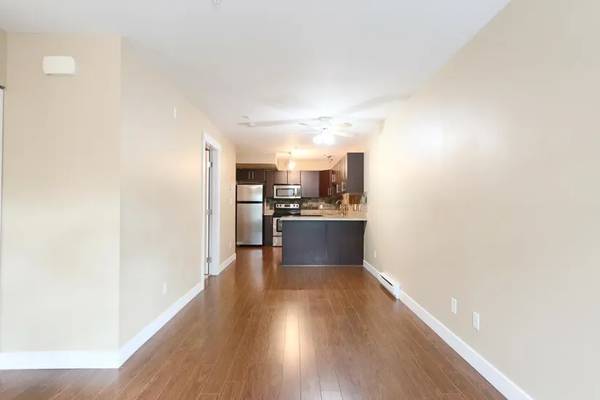


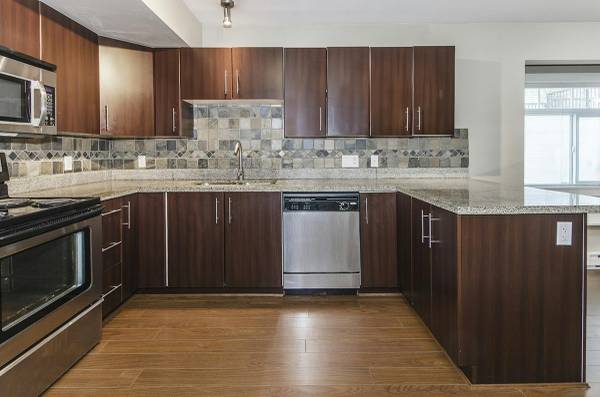


Two markets in one postcode, and only one needs a council's permission
Burnaby is the clearest worked example in the region, because the split is visible from the street.
Central Park/Metrotown averaged $1,813 for a one-bedroom in October 2025 and 86% of its purpose-built stock predates 1980. Those are the walk-ups south of Kingsway. Southeast Burnaby, around Edmonds and Highgate, averaged $1,564 with 88% pre-1980 — the cheapest walk-up belt north of the Fraser and the deepest concentration of single-owner stock outside the West End. The glass towers you actually see in a listings search there are overwhelmingly rented condominiums, which CMHC surveys separately and which averaged $2,900 for a two-bedroom across the CMA against $2,364 in purpose-built buildings, a premium of about 23%. Two markets, one postcode, and a listings site shows you both without labelling either.
For a pet owner the premium is only half the cost. The tower also adds a strata council, a filed pet bylaw you had no part in, a lift and a parkade that count as common property, and neighbours whose complaint has a formal channel attached to it. The walk-up adds none of those. If you are choosing between north and south of Kingsway, our guide to Burnaby's neighbourhoods for renters sets out what each side of that line is made of; the pet-specific reading is that the older, cheaper side has one gate and the newer, dearer side has two.
The same split runs through Brentwood, No. 3 Road in Richmond, the Cambie corridor, Yaletown, Coal Harbour and Surrey City Centre. Wherever a district's listings are dominated by towers built after 2005, you are shopping in a market where the strata decides. And it runs in reverse up Lonsdale: the City of North Vancouver averaged $1,918 with 65% of its purpose-built stock pre-1980, which is a genuine walk-up belt inside two fare zones, sitting next to a District of North Vancouver average of $2,350 that is mostly newer and mostly stratified. The difference between the two North Vancouvers is larger for a dog owner than the $432 rent gap suggests. Which building type you are actually looking at, and why it changes the tenancy rather than only the price, is the subject of our comparison of the types of rental housing in this region.
Where a dog is a house-form problem
Size is the constraint that no amount of building-type cleverness solves. A strata that permits "one dog" frequently permits it subject to a weight limit, and even where it does not, a 30-kilogram dog in a 550-square-foot unit on the eleventh floor is a lift trip away from every complaint the building has.
House-form rental is the answer people actually arrive at, and its geography is entirely different from the apartment map. Secondary suites, laneway and coach houses, rented houses, duplex halves and non-strata townhouses concentrate in East Vancouver east of Nanaimo Street, across Surrey, in Delta, Maple Ridge and the older parts of Coquitlam. None of it is in the CMHC survey, so there is no published average rent for any of it, and every dollar figure you see quoted is scraped asking-rent data rather than a measurement.
Three things change when you go this route, and they cut in both directions.
You get ground level and often a yard, which removes the corridor, the lift and the common property from the equation entirely. There is no strata, so there is no bylaw and no council, and the leash rule that generates most tower complaints simply does not apply to your own back garden.
Your landlord usually lives upstairs. One hydro meter for the whole house generally means utilities are inside the rent, and the person controlling the thermostat is also the person who will hear the dog at 6 a.m. The permission you are seeking is personal rather than institutional, which makes it easier to get and easier to lose.
Section 4 of the Residential Tenancy Act may put you outside the Act altogether. Section 4(c) excludes living accommodation in which the tenant shares bathroom or kitchen facilities with the owner of that accommodation. Sharing means no deposit cap, no notice periods, and no access to the Residential Tenancy Branch — including none of the pet-deposit protections set out above. A self-contained suite with its own kitchen and bathroom is covered; a room in the owner's house is not. Our guide to house-form renting in Metro Vancouver works through that test in full, and it matters more to a pet owner than to most tenants, because the arrangement that gets you the yard is the one most likely to fall outside the statute.
South of the Fraser, and the assumption that gets it wrong
The instinct is that cheaper and further out means easier with a pet. Half of that is right.
Surrey averaged $1,602 for a one-bedroom in October 2025 with 4.3% vacancy, genuinely looser than anything inside the city, and 49% of its purpose-built stock predates 1980. It also carries a three-zone TransLink pass at $211.65 a month against $117.20 in Zone 1, effective 1 July 2026, which is $94.45 a month and $1,133.40 a year on a weekday-daytime SkyTrain commute. The house-form supply south of the Fraser is where the yards are, and it is the single largest reason a large-dog household ends up in Surrey, Delta or Maple Ridge rather than Kitsilano.
Langley is the counter-example and it is instructive. It averaged $1,765, dearer than Surrey, New Westminster, Richmond and Southeast Burnaby, and only 34% of its purpose-built stock predates 1980, the newest profile in the region. New stock means strata stock, filed bylaws and market pricing, because none of its tenancies are old enough to have fallen behind the cap. Distance from downtown does not buy a pet a home. Building vintage does, and the two are not correlated the way the map suggests.
New Westminster is the compromise most pet owners miss. It averaged $1,645 with 73% of its purpose-built stock pre-1980, sits in Zone 2 rather than Zone 3, and holds a dense uptown grid of walk-ups on a hill that is largely unstratified. Surrey at $1,602 plus a three-zone pass comes to $1,813.65 a month; New Westminster at $1,645 plus a two-zone pass comes to $1,801.70. The cheaper city is the dearer address once the fare is counted, and the one closer in has the older stock. Our comparison of every survey zone in the region sets rent, fare zone, commute and stock age side by side if you want to price the trade properly.
One-bedrooms in New Westminster, two fare zones from downtown
17 matches as we last checked, confirmed today. This block is rebuilt from the live feed, so it is never the list that was here when the article was written.


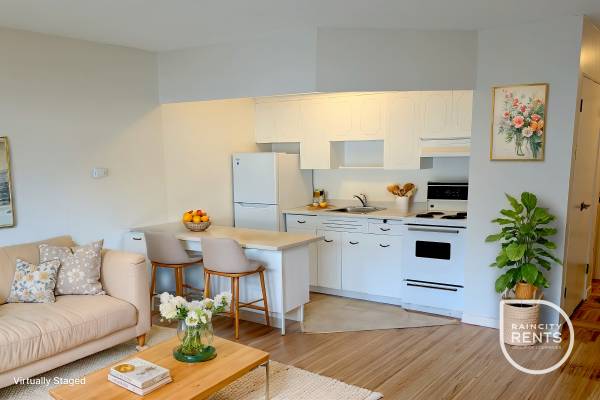


Reading the pet line in a listing
"Pet-friendly" is marketing copy, not a term of the tenancy, and section 18(1)(a) is the reason it can mean almost anything. The Act lets an agreement restrict size, kind or number, all three restrictions are lawful, and the phrase is usually concealing at least one of them. Advertisements here use five or six formulations and they are not synonyms.
| What the listing says | What it usually means | What to confirm before you view |
|---|---|---|
| Pet-friendly building | Describes the building, not your unit or your animal; in a strata, that the bylaw permits some pets on the bylaw's terms | Whether dogs are permitted at all, and on what terms |
| Cats OK, or small dogs considered | A restriction under s. 18(1)(a), commonly a weight ceiling in the 20–30 lb range | The exact number in pounds, in writing |
| Pets negotiable, or pets on approval | No term exists yet; screened case by case | Whether a decision can be given before you apply |
| One pet allowed with strata approval | Two gates in one sentence, and the second is the strata's | Whether approval is a form, a fee, a council decision or a registration |
| Pets allowed | Genuinely open, and almost always purpose-built rental in single ownership | Nothing; this is the rare one |
| No pets | Lawful and common | Nothing, unless the building is purpose-built, in which case one email is worth sending |
That last row deserves its own sentence. A single-owner landlord can change their own mind and a strata cannot change its bylaw for you, so a "no pets" line on a purpose-built walk-up is a policy and a "no pets" line on a rented condo is usually a rule. The email costs nothing and the base rate is not zero.
Weight limits are worth one caution. They are lawful and enforceable, and the weight is usually measured at the point the landlord meets the dog rather than at the point the dog stops growing. A nine-month-old animal at 24 lb under a 25 lb ceiling is a future breach, and it is better to raise the adult weight yourself than to have it raised for you in month fourteen.
Five questions, asked by email before you spend a Saturday on viewings, will kill most of the bad matches:
- Is the building purpose-built rental or a strata lot?
- If it is a strata, will you send me the current pet bylaw and the Form K?
- What species, what weight limit, and how many animals?
- Will the pet permission be written into the tenancy agreement?
- Is there a pet damage deposit, and at what amount?
Ask them in writing, because the answers become evidence if the terms change between the viewing and the lease. A landlord who answers all five in one reply is a landlord who has done this before. Question two is the one people skip and the one that voids the other four answers.
A cat and a dog are not the same search
The single largest lever in this subject is species, and it is invisible in every rent table on this page because nobody publishes it. What can be reasoned from is the statute, and the statute is unusually explicit.
Standard Bylaw 3(4) permits one dog or one cat, so the default strata treats them identically. Filed bylaws almost never do. The restrictions section 18(1)(a) authorises are size, kind and number, and all three of them bite harder on a dog. A weight ceiling is a size restriction and only dogs have one. A breed list is a kind restriction and only dogs get one. The leash obligation in Standard Bylaw 3(3) applies on common property, which is a corridor problem for a dog and a non-event for an indoor cat. Guideline 1's carpet rule turns on whether pets were "not caged", which catches both. And the disturbance ground in section 47(1)(d) is reached by barking far more often than by anything a cat does.
The practical consequence is that "pet-friendly" in a Metro Vancouver listing frequently resolves to cats only, and a dog household is searching a materially smaller pool than a cat household at the same rent, in the same district, on the same day. Two cats is often a harder ask than one cat and easier than one dog, because two animals breaches a number restriction while one large animal breaches a size restriction, and number restrictions are the ones landlords relax.
Three moves follow from that, in order of how much they widen the search.
Ask for the weight limit as a number rather than as an adjective. "Small dogs considered" costs nothing to write and commits to nothing. A stated ceiling of 25 lb tells you whether to apply, and a landlord who will not state one is usually deciding at the viewing, which means the dog should come to the viewing.
Treat number and size as separate negotiations. A household with two cats applying to a one-pet building has a specific, answerable request: permission for two animals of a kind the bylaw already permits, in writing, with one deposit — because section 20(d) caps the deposit at one per agreement irrespective of how many pets are permitted, so the landlord's exposure does not double when the count does. That is a much easier sentence to say yes to than a general relaxation.
For a large dog, stop searching apartments early. The size restriction is the one that does not negotiate, and every hour spent on towers is an hour not spent on ground-level house-form stock where the constraint does not exist. That decision is better made in week one than in week seven.
Timing matters here too, and in the pet owner's favour for once. Metro Vancouver's rental calendar peaks between May and September, when student demand and the summer moving season put the most competition against every listing. A pet search run in November against a January start faces a thinner list of vacancies but far fewer competing applications on each one, and a landlord choosing between two applicants rather than forty is a landlord who will read the pet résumé. If your move date has any give in it, spend the flexibility on the off-season rather than on the rent.
The application, and the packet that answers the objection before it is raised
A landlord refusing a pet is not usually refusing an animal. They are refusing two risks they cannot price: damage they will have to prove at the Residential Tenancy Branch, and noise complaints from neighbours they will have to field. A pet application works when it converts both risks into documents.
Assemble the file before you start rather than during. A one-page pet résumé does more work in this market than it has any right to: species, breed, age, weight, spay or neuter status, vaccination record with dates, the municipal licence number if the animal is a dog you already own, a note on whether the animal is crate-trained and how many hours a day it is alone, one photograph, and a line of reference from the previous landlord confirming there was no damage and no complaint. That is the whole document. It attaches to the ordinary application rather than replacing it.
Send it unprompted. A landlord reading forty replies is looking for a reason to shortlist five, and a pet that arrives as a documented known quantity is a different proposition from one that arrives as a question at the end of a viewing.
What does not belong in it is the over-disclosure a nervous applicant volunteers. The Personal Information Protection Act limits what a landlord may collect to what a reasonable person would consider appropriate in the circumstances, and a pet does not widen that boundary. Our guide to what a BC rental application may and may not ask for sets out where the line sits and how to decline the rest without losing the unit.
One offer to refuse on the spot. If a landlord says yes to the pet in exchange for monthly pet rent, that term is unenforceable for the reasons set out above, and signing it changes nothing — which cuts both ways. You may end up in a tenancy where the landlord believes they are owed $50 a month and you believe you owe nothing, and that argument runs for the life of the lease. Better to have it in week one, in writing, before there is a tenancy to lose.
Get the yes in writing, and write it narrowly
RTB Policy Guideline 28, revised July 2025, says that "it is always acceptable and advisable for the parties to write down and sign an agreement that pets or a certain pet is acceptable despite a pets clause in the tenancy agreement." Take that literally. A verbal yes at a viewing, from a leasing agent who leaves the company in March, is worth nothing at a hearing, and section 13(2) requires the written agreement to set out the standard terms and the particulars of the tenancy in any event.
The written permission should name the animal, its species, its breed and its approximate adult weight. Naming it matters more than it sounds. Permission attaches to that animal rather than to a standing right to keep pets, and the same is true of the section 123(2) strata protection for a pet already in residence when a bylaw passed. Both die with the animal and neither transfers to the one you get afterwards. If you expect to replace a pet during a long tenancy, the time to negotiate that is now.
Watch for a permission drafted as revocable — "the landlord may withdraw consent on 30 days' notice." A landlord cannot end a BC tenancy on 30 days' notice for any reason, because the grounds and notice periods in the Act are closed and none of them is 30 days for cause. What such a clause is really trying to do is manufacture a future breach: withdraw the permission, then serve on the ground that you are keeping a pet without consent. Strike it, or bound it, so that consent may be withdrawn only for a specified written reason with a reasonable time to comply. When a no-pets clause is a material term, and when a landlord who has waved at your dog for six months has waived the right to end the tenancy for that breach, is set out in full in the guide to refusing pets in BC.
Move-in day is where the pet deposit is actually decided
Whether you get the pet deposit back is determined almost entirely by two pieces of paper filled in at either end of the tenancy.
Sections 23 and 35 require a joint walkthrough at move-in and move-out on the RTB's Condition Inspection Report, Form RTB-27. Section 23 is specific that an inspection is also required when a tenant acquires a pet during a tenancy and the landlord agrees to it, which is the one most people skip. Skip the move-in inspection after the landlord has offered two opportunities and your right to the return of the deposit can be extinguished under section 24(1). If the landlord fails to offer two opportunities, or does the inspection and never gives you a signed copy, their right to claim against the deposit for damage is extinguished instead.
A pet tenancy needs a handful of specific entries on that form, and none of them appear on the standard template:
| What to record at move-in | Why it decides the claim later |
|---|---|
| Age of the carpet, and the year it was last replaced | Guideline 40 depreciates awards over a 12-year useful life for carpet; a 2014 carpet has almost nothing left to claim in 2026 |
| Condition of door frames and trim from floor to about a metre | Dog-height scratching is the commonest single pet claim |
| Balcony deck surface and any existing staining | Outdoor damage is charged to the pet deposit as readily as indoor |
| Window sills, screens and screen doors | Cat damage concentrates here and is invisible in a five-minute walkthrough |
| Baseboard corners and the carpet edge at each doorway | Where urine damage shows first and where a landlord will look first |
Photograph everything, date-stamped, on move-in day, and record the carpet's age as a written note on the report rather than as a memory of a conversation. The condition inspection report guide covers how to complete one so that it protects you.
Licensing, insurance, and the strata's second rulebook
Three obligations attach to the animal rather than to the tenancy, and all three are yours.
The licence. Every municipality in Metro Vancouver requires dogs to be licensed under its own animal control bylaw, with a substantially higher fee for an unaltered animal and a penalty for renewing late. Several also cap the number of dogs per dwelling unit independently of anything in your lease, which is the rule that catches households merging two pets into one apartment. Fee schedules are revised annually and vary by municipality, so use the current schedule for the municipality you are moving to rather than the one you are leaving; secondhand figures go stale fast, including any printed in a guide. Cat licensing is not universal here, and where it exists it is a local choice. Get the dog licence before you sign if you can — a licence number in the application does more work than a paragraph of reassurance.
The insurance. Most Metro Vancouver tenancy agreements now include a term requiring tenant insurance, and failing to hold it is a breach of the agreement in its own right. The number to check is not the contents limit but the personal liability limit, because a dog bite is the claim that produces a six-figure demand rather than a $2,000 one. Premiums depend on the coverage limit, the building type and its claims history, your deductible, whether you bundle with a car policy, and the animal, so no page can quote you one. What can be said precisely is where breed restrictions come from, because pet owners routinely attribute them to the wrong party. BC has no provincial breed ban. Where an insurer declines or surcharges a particular breed that is an underwriting decision rather than a legal restriction, it is not a landlord problem and not a Residential Tenancy Branch problem, and it is the one gate you can shop around. Name the breed when you get the quote rather than after a claim, and note that a landlord requiring cover will want to see it before handing over keys. What the policy does and does not cover is set out in our guide to tenant insurance in BC.
The strata. If you are renting a condo, a body you have no contract with can act against you directly. This is the part of the subject worth reading before you decide a bylaw is a formality.
| Power | What it means | Source |
|---|---|---|
| The strata may fine the tenant | Not only the owner — the tenant, and for a visitor's contravention too | SPA s. 130(2) |
| Maximum fine | $200 for each contravention of a bylaw, $50 for a rule | Strata Property Regulation s. 7.1 |
| Maximum frequency | Every 7 days for a continuing contravention | Reg. s. 7.1 |
| The bylaws must state the ceiling | The strata must set its own maximum in its bylaws, and may not exceed the regulation | SPA s. 132 |
| Landlord and owner are on the hook too | The strata may collect from tenant, landlord and owner, up to the total; the tenant then owes the landlord what they paid | SPA s. 131 |
| Before any fine | A complaint received, written particulars given, a reasonable opportunity to answer including a hearing if requested, and notice to the landlord and owner | SPA s. 135(1) |
| "Hearing" means | An opportunity to be heard in person at a council meeting | Reg. s. 7.2 |
| The strata may end your tenancy | Repeated or continuing contravention of a reasonable and significant bylaw that seriously interferes with another person's use and enjoyment lets the strata corporation give notice under RTA s. 47 | SPA s. 138 |
A continuing pet contravention fined at the maximum every seven days is $200 a week. That is the ceiling rather than the norm, and section 135 is a real procedural gate that councils lose on regularly: no complaint, no written particulars, no opportunity to answer, no valid fine. Request the particulars in writing and request the hearing, both by email, on the day the notice arrives. Note also section 135(3) — once the strata has complied once for a given contravention, it may fine for the continuing contravention without repeating the process, so the first response is the one that counts.
Section 138 is the one to sit with. Your landlord is not the only party who can end your tenancy in a strata; the corporation can serve the notice directly, and your landlord's approval of the dog is not a defence to it. None of this exists in a purpose-built building. There is no second body with the power to fine you and no second body with the power to end your tenancy. That is what the one-yes stock is really buying.
One-bedrooms on the North Shore within reach of Lonsdale
147 matches as we last checked, confirmed today. This block is rebuilt from the live feed, so it is never the list that was here when the article was written.




When the complaint arrives
Barking, a scratched door, a neighbour in the lift. There are two separate tracks and they run on different clocks, so identify which one you are on before you reply to anything. The strata track is the section 135 procedure above. The landlord track is a One Month Notice to End Tenancy for Cause under section 47, and the grounds a pet can reach are four:
| Ground | Section | What the landlord has to establish |
|---|---|---|
| Significantly interfered with or unreasonably disturbed an authorized person | s. 47(1)(d) | That the disturbance was unreasonable, not merely that it occurred. "Authorized person" is defined in s. 1 and covers the landlord, other tenants and occupants, and people lawfully on the property |
| Extraordinary damage to the unit or the residential property | s. 47(1)(f) | Damage beyond ordinary, which is a high bar, and depreciation still applies to the award |
| Damage not repaired within a reasonable time | s. 47(1)(g) | That the s. 32(3) obligation was engaged and a reasonable time has passed |
| Failure to comply with a material term, not corrected after written notice | s. 47(1)(h) | That the pets clause is a material term at all, and that written notice to correct was given first |
Two deadlines matter and only one of them is yours. Under section 47(2) the notice cannot take effect earlier than one month after the date it is received, and must land the day before rent is due. You have 10 days from receiving it to dispute under section 47(4). Ten, not fifteen and not thirty. Section 47(5) says a tenant who does not apply in time is conclusively presumed to have accepted that the tenancy ends, whatever the merits, and the argument about whether the dog was actually barking never gets heard. The guide to eviction notices in BC sets out what a valid notice must contain and how the clock is counted.
The evidence that wins the disturbance cases is dull and contemporaneous: a dated log of when the animal was alone and for how long, a recording covering the hours in dispute, the written response you sent to the first complaint, and a neighbour or two willing to say they hear nothing. Start it the day the first complaint arrives, not the day the notice does. Section 28 gives every tenant the right to quiet enjoyment, including freedom from unreasonable disturbance, and the neighbour complaining about the barking has that right too. A defence that treats their complaint as illegitimate rather than as inaccurate tends to lose.
One under-discussed friction point. Under section 29 a landlord may enter with at least 24 hours' and not more than 30 days' written notice stating the purpose, for an entry between 8 a.m. and 9 p.m. Nothing in that section lets you refuse a properly served entry because the dog will be home alone, and refusing is its own breach. Agree in writing, early, that you will crate the animal or be present for any noticed entry. Bite incidents and escaped-animal disputes overwhelmingly begin with a contractor opening a door nobody warned them about, and what a landlord may and may not do on entry is covered in the limits on landlord conduct in BC.
Moving out with the deposit
Section 37(2) is the standard: leave the unit "reasonably clean, and undamaged except for reasonable wear and tear." Reasonably clean, not professionally staged.
One asymmetry costs pet-keeping tenants real money and it is worth budgeting for from the start. Policy Guideline 1, revised July 2025, says a tenant is generally responsible for steam cleaning or shampooing the carpets after a tenancy of one year — and separately, at any length of tenancy, if they or another occupant "has had pets which were not caged" or smoked in the premises. A ten-month tenancy with no animal owes nothing for the carpet. The same tenancy with a cat owes a professional clean. That is a real, recurring, non-refundable cost, it is entirely lawful, and it is the single most reliable deduction a landlord will make from a pet renter's deposit. Book it yourself rather than letting the landlord book it and bill you, keep the receipt, and attach it to the move-out report.
Replacement is a different argument and it is the one worth having. Policy Guideline 40, updated 5 February 2025, tells arbitrators to reduce an award by the portion of an item's useful life already used up, because putting a new thing where an old thing was leaves the landlord better off than they were before the damage.
| Item | Estimated useful life | Source |
|---|---|---|
| Interior paint | 6 years | RTB Policy Guideline 40, 5 Feb 2025 |
| Carpet | 12 years | RTB Policy Guideline 40, 5 Feb 2025 |
| Laminate flooring | 15 years | RTB Policy Guideline 40, 5 Feb 2025 |
| Dishwasher | 10 years | RTB Policy Guideline 40, 5 Feb 2025 |
| Interior hollow-core door | 20 years | RTB Policy Guideline 40, 5 Feb 2025 |
| Window or door screen | 5 years | RTB Policy Guideline 40, 5 Feb 2025 |
The guideline's own worked example is a pet case. A tenant's dog jumps on the dishwasher door and breaks it; the dishwasher was five years old; the landlord replaces it with a comparable unit for $900; and because the old one was halfway through its ten-year useful life, "an award of approximately $450 may be appropriate." Apply the same reasoning to the claim you are most likely to face. A landlord says a dog ruined the carpet and replaces it for $3,000. If the carpet was nine years old, nine of its twelve years were already gone, and the appropriate award is roughly a quarter of the cost — about $750, not $3,000. A carpet older than twelve years reached the end of its useful life before the damage and attracts a nominal amount at most. Almost nobody raises this, and it is the difference between losing a pet deposit and losing part of one.
Then the allocation rule that exists only for pet tenancies. Under section 38(7) a pet damage deposit may be applied only to damage caused by a pet unless you agree otherwise. A landlord holding $1,188.50 in each cannot spend the pet deposit on a scuffed hallway wall, an unreturned key or unpaid rent. Make them itemise which deposit each line is coming out of.
The rest is the ordinary clock. Give a forwarding address in writing on the day you leave and keep proof. Section 38(1) gives the landlord 15 days from the later of the tenancy ending and receiving that address to repay both deposits with interest or file a claim against them, and section 38(6) makes a missed deadline cost them double. That doubling applies to the pet damage deposit as well as the security deposit, which on a $2,377 tenancy is a further $1,188.50 of doubled money rather than one deposit's worth.
The shortlist, ranked by how many yeses you need
| Stock type | Whose permission you need | Where it concentrates | Rent and supply signal, Oct 2025 |
|---|---|---|---|
| Pre-1980 purpose-built walk-up | Landlord only | West End, Southeast Burnaby, Metrotown, Kitsilano, New Westminster, Lower Lonsdale | CMA 1-bed $1,807; cheapest-quartile vacancy 1.1% |
| Post-2000 purpose-built rental | Landlord only, but against a written corporate policy | Downtown, Brentwood, Sapperton, Surrey City Centre, Langley | At or above asking market; vacancy loosest here at 5.0–6.7% |
| Secondary suite or laneway house | Landlord only, usually living upstairs | East Vancouver, Surrey, Delta, Maple Ridge | Unmeasured; check the s. 4(c) shared-facilities test |
| Rented house, duplex half, non-strata townhouse | Landlord only | South of the Fraser, East Vancouver | Unmeasured |
| Rented condominium apartment | Landlord and the filed strata bylaw | Tower districts region-wide | CMA 2-bed $2,900; vacancy 1.5% |
| Strata townhouse | Landlord and the filed strata bylaw | Richmond, Coquitlam, Surrey, Langley | Unmeasured |
Work down that table rather than across a map. Two rows need one conversation and four rows need two, and in a market where the cheapest quartile sits at 1.1% vacancy, halving the number of parties who can refuse you is worth more than any other filter you can set.
One row in it is more useful than its position suggests. Post-2000 purpose-built rental is where the vacancy actually is — the third and top quartiles at 5.0% and 6.7% — and it has no strata above it, so it is the only part of this market that combines slack supply with a single decision-maker. What it has instead is a written corporate pet policy applied identically across every building in the portfolio, which means the answer is the same at all of them and one email settles the whole operator rather than one address. That is worth ten viewings. Find out the policy once, then either work the portfolio or drop it entirely.
When the answer is no
Most answers will be no, and a refusal in this market is rarely a negotiation opening. Treating every one of them as though it were is how a pet search turns into a three-month project, so it is worth being able to tell in one reading which refusals have anything behind them and which are final.
A purpose-built landlord's no is a policy, and policies have exceptions. It is worth one reply that supplies what the policy is protecting against: the licence number, the reference, the sterilisation and vaccination dates, an offer to meet the animal, and the observation that a pet damage deposit is available to them and capped at half a month whatever they decide. Nobody publishes a conversion rate for that email and this page is not going to invent one, but it costs four minutes and the base rate is plainly not zero. Send it once, do not send it twice.
A strata's no is a bylaw and there is nothing to work with. Your landlord cannot waive it, the council cannot grant you a variance from it, and the three-quarters vote that would change it is not going to be convened for a prospective tenant. Read the bylaw, confirm it says what you were told, and move on the same day.
A refusal that turns on a certified guide or service dog is a different category and should not be accepted at all. Section 3(2) of the Guide Dog and Service Dog Act prohibits it outright for a unit represented as available, and section 18(3) of the Residential Tenancy Act makes the pet provisions subject to that Act. A refusal that turns on a disability-related need for an animal that is not a certified service dog is a Human Rights Code matter with a one-year filing limit, and the Human Rights Tribunal rather than the Residential Tenancy Branch is where it goes.
And a refusal that arrives with a demand attached — monthly pet rent, a non-refundable pet fee, a second pet damage deposit for the second cat — is not a refusal. It is an offer of a tenancy on terms the Act does not permit, and the answer is to ask for the same permission with the unlawful term removed, in writing, before anything is signed.
What this does not fix
Everything above is a method for finding the yeses faster and for holding on to the money once you have one. None of it produces a yes that was not going to be there. BC gives a tenant no right to keep a pet, a landlord may decline your application because of your cat and need not tell you why, and in a market where the cheapest quartile of purpose-built units sat at 1.1% vacancy in CMHC's October 2025 survey, they can afford to. The law here governs what happens after you have the tenancy. Getting one is a supply problem, and the supply problem is not solved by knowing section 18.
What actually shortens a pet search, in order: filter for purpose-built rental in single ownership first, because it removes the strata bylaw layer entirely and it is where the genuine yeses are; ask the five screening questions by email before viewing; make the landlord produce the bylaws and the Form K under section 146 rather than chasing them yourself; carry the one-page packet so the answer can be given at the viewing rather than after a week of silence; take the written permission before you take the keys; and record the carpet's age on the move-in report. Then licence the animal, check the liability limit on the insurance, and keep the correspondence.
Widen the geography earlier than feels comfortable. The single-owner wood-frame stock that takes dogs is concentrated in the older walk-up districts rather than the glass towers, which means Burnaby, New Westminster and East Vancouver return more workable results per hour of searching than the areas most people start in. A place that says yes forty minutes further out is a better outcome than three months of no.
Nothing here is legal advice. The Residential Tenancy Branch answers calls at 1-800-665-8779, the Tenant Resource and Advisory Centre runs a free tenant infoline, the BC SPCA publishes resources for renters with animals, and the rest of our tenant guides cover the other parts of a BC tenancy. Statute, regulation and RTB policy guidelines are as they stood on 11 August 2026.
Keep reading
The rest of what we have written about renting here.
Renting in Vancouver
Renting a House, Suite or Townhouse in Metro Vancouver
Four kinds of house-form rental in Metro Vancouver: how rent, utilities, repairs and eviction risk differ between a house, a suite, a laneway and a townhouse.
Renting in Vancouver
Every SkyTrain Station, With the Rent and the Fare Zone
All 54 SkyTrain stations with the fare zone, the CMHC rent average and the ride to Waterfront, plus what the monthly pass really costs a renter.
Renting in Vancouver
3 Bedroom Rent in Vancouver: What Families Pay and What They Are Owed
Metro Vancouver holds 5,658 purpose-built rentals with three bedrooms or more. What the space costs, what childcare adds, and what a landlord may never ask.
Tenancy law
The BC Tenancy Agreement, Clause by Clause
A clause-by-clause walkthrough of BC's tenancy agreement, form RTB-1: what each clause commits you to, which blanks matter, and which added terms are void.
Money
Co-op Housing in Vancouver: What It Costs, and What You Give Up
A share is $1,000 to $7,000 and refundable. The waitlist runs three months to three years. And the Residential Tenancy Act does not protect you at all.
Money
Commuting to UBC: What Every Option Costs
Every way to reach UBC, priced: U-Pass at $47.85 a month, Evo at $0.49 a minute, a $1,153.93 parking permit, plus scheduled bus times from ten places.