Renting in Vancouver
Types of Rental Housing in Metro Vancouver: A Renter's Map
Purpose-built, condo, suite, co-op, non-profit, pad or residence. Which of Metro Vancouver's rental types you sign for decides which law protects you.
Updated 2026-08-12 · 58 min read
Metro Vancouver does not have a rental market. It has about nine of them, running side by side, and the one you end up in decides more about your position than the rent does. Two neighbours on the same corridor can be under different rent rules. A basement suite and the room above it can be on opposite sides of a jurisdictional line. A parent moving between two wings of the same seniors' building loses the Residential Tenancy Act on the way across the lobby.
This page is a map of those types: what each one is, who the landlord actually is, which rulebook applies on top of the Act, whether the Act applies at all, and what ends the tenancy. It is organised the way the decision is actually made — the advertised market first, then the housing that is allocated rather than marketed, then the categories that sit outside provincial tenancy law altogether.
Everything below reflects the Residential Tenancy Act, the Residential Tenancy Regulation, the Strata Property Act and its regulation, the Manufactured Home Park Tenancy Act and its regulation, Residential Tenancy Policy Guideline 27 as revised July 2024, BC Housing's published programme pages and CMHC's October 2025 Rental Market Survey, as they stood on 11 August 2026. Where a figure moves with the market, the date it was measured is stated. Where no figure exists, that is stated too.
Two out of three renters here live in something that was not built to be rented
CMHC's Rental Market Survey counts one thing: purpose-built rental structures with three or more units. In the Vancouver census metropolitan area that universe was 129,351 units at the October 2025 survey, published on 11 December 2025. The 2021 Census counted about 394,710 renter households in the same CMA. The geographies and the counting units are not identical and the two figures are four years apart, but the gap is far too large for that to matter: roughly two out of every three renter households in this region live in something built for another purpose and later let out.
That something is what CMHC calls the secondary rental market, and it is four products wearing one label — a condominium apartment somebody bought as an investment, a secondary suite in a house, a laneway or coach house, and a rented house, duplex half or townhouse. They are not variations on a theme. They differ in who your landlord is, whether a second rulebook applies on top of the Act, how the rent moves, and whether you can be evicted so that a stranger's daughter can move in.
Only one slice of it is measured with any consistency. CMHC's Condominium Apartment Survey, which runs alongside the main survey in seventeen Canadian centres, publishes average rents for rented condominium apartments. Everything else — suites, laneways, rented houses — sits outside every survey universe in the country, which is why every dollar figure quoted for them is scraped asking-rent data rather than a measurement. Our breakdown of what average rent figures actually measure sets out which sources survive scrutiny and why the survey number and the asking number are hundreds of dollars apart.
Purpose-built rental is the residual category, and the simplest one
The other third of the market is the housing this whole vocabulary was invented for: a building put up to be rented, held as a single asset by one owner. That distinction decides more than the finishes: with no strata above the landlord, their yes is the only yes required, which is why the stock that accepts pets concentrates here. In this region that owner is usually a REIT, a pension fund, a family company that has held the block since the 1970s, or a non-profit society. The consequences run all the way down.
There is no second rulebook. The building manager is an employee rather than the owner, which means repairs run through a maintenance budget rather than through somebody's personal cash flow, and it also means nobody has a stake in whether you personally stay. Rent increases arrive annually, at the cap, on the correct form, because a professional operator knows what the cap is and knows that serving a defective RTB-7 costs them the increase for a year. The flip side is that they never forget to serve it. A great many individual landlords in the secondary market simply do not raise the rent for years; almost no purpose-built operator makes that mistake.
The eviction profile is the real difference, and it is why this stock is worth paying attention to even when the finishes disappoint. Section 49(6.1) bars a landlord's-use, family-corporation-use or purchaser's-use notice where the building contains five or more rental units and is either not strata-titled, or strata-titled with every rental unit owned by the same owner. A purpose-built building of any size satisfies that test on the first limb. The single most common way a Metro Vancouver tenancy ends — somebody is moving in — is closed off entirely.
What replaces it is renovation, and the province rebuilt that route in 2024 so that it no longer runs on a notice at all. Under section 49.2 a landlord who wants the unit empty for renovations or repairs has to apply to the director and satisfy four conditions at once: good-faith intent plus all the necessary permits and approvals; work that genuinely requires the unit to be vacant; work necessary to prolong or sustain the use of the unit or the building; and no other reasonable way to achieve the vacancy. Only then does an order issue, and the effective date must be at least four months after the order is made. Section 51.4 pays you one month's rent. In a building of five or more units, section 51.2 gives you a right of first refusal on the renovated unit if you tell the landlord in writing before you leave that you intend to take it — after which the landlord must, at least 45 days before completion, give you notice of the availability date and a tenancy agreement starting on it. Section 51.3 sets the price of ignoring that at twelve times the monthly rent. Those provisions exist because the previous version of the rule was being used to reset rents, and they are the reason a renoviction in purpose-built stock is now a hearing rather than a letter.
The trade-off is age and amenity. Most of the region's purpose-built stock went up between 1955 and 1975, which is why in-suite laundry, a dishwasher, air conditioning and a second bathroom are the exception rather than the rule in a building that rents for several hundred dollars a month less than the tower across the street. CMHC recorded 3.7% vacancy across the Vancouver CMA in October 2025, and that number describes purpose-built rental only — it is the one part of the market where a published vacancy rate means anything, and it varies enormously by zone.
One more thing follows from the ownership structure. Because these buildings turn over slowly and the operator has been applying the cap for decades, purpose-built rental holds the deepest below-market tenancies in the region: the sitting tenant paying $1,100 for a two-bedroom is almost always in a 1968 walk-up, not in a condo. That is also why the purpose-built average in the CMHC table sits so far below the condo average, and it is the subject of the section on rent behaviour further down.
The rented condominium apartment is the largest measured piece of the secondary market
This is the single largest measured segment of the secondary market, and in the towers of Brentwood, Metrotown, Yaletown and central Richmond it is effectively the whole rental supply. Buildings completed since roughly 2010 in those nodes are overwhelmingly strata-titled and sold to individual buyers, a large share of whom never intended to live there.
The rent premium over purpose-built is real, measured and larger than most renters expect.
| Measure | Purpose-built rental | Rented condominium apartment |
|---|---|---|
| Average two-bedroom, Vancouver CMA, October 2025 | $2,364 | $2,900 |
| Average one-bedroom, Vancouver CMA, October 2025 | $1,807 | Surveyed separately by CMHC |
| Surveyed universe, Vancouver CMA | 129,351 units | Counted in the Condominium Apartment Survey |
Both columns come from CMHC's October 2025 Rental Market Survey release, published 11 December 2025; the condominium column is from the Condominium Apartment Survey tables published with it.
A $536 monthly gap on a two-bedroom is $6,432 a year. Some of it buys real things: in-suite laundry, a dishwasher, a gym, a parkade stall, a building finished this decade rather than in 1974. The rest of it is a structural artefact, explained further down, and it is the more important half.
Four things change when your landlord is one person who owns one unit in a 200-unit tower.
Personal-use eviction is back on the menu. Section 49(6.1) of the Act bars a landlord's-use, family-corporation-use or purchaser's-use notice only where the building the rental unit is located in contains five or more rental units and is either not strata-titled, or strata-titled with all the rental units owned by the same owner. A 300-unit strata tower with 90 different investor-owners fails that test on the second limb. Living in a large building buys you nothing here. The notice period for those occupancy grounds is three months with 21 days to dispute, prescribed by sections 42.2 and 42.3 of the Residential Tenancy Regulation, and the notice must be generated through the Residential Tenancy Branch's portal as an RTB-32L or RTB-32P rather than typed onto a downloaded PDF — our guide to eviction notices in BC sets out the defects worth checking for.
The definitions inside section 49 are worth knowing before you accept one of these notices, because they are narrower than the letter usually implies. A "close family member" is only the landlord's parent, spouse or child, or the parent or child of the landlord's spouse. A sibling does not qualify, and neither does a cousin, a nephew or an in-law outside that list. The individual giving the notice must hold a reversionary interest in the unit exceeding three years and not less than half of the full reversionary interest. A "family corporation" means one where all the voting shares are held by one individual, or by that individual plus their siblings or close family members. On a purchaser's-use notice under section 49(5), the sale agreement must be in good faith, every condition on which the sale depends must already have been satisfied, and the purchaser must have asked the landlord in writing to give the notice — and section 49(7) requires the notice itself to carry the purchaser's name and address.
Section 51 is the money. A section 49 notice entitles you to one month's rent, payable on or before the effective date, and you may withhold it from your last month's rent rather than chasing it. If the stated purpose was not accomplished within a reasonable period, or the unit was not used for that purpose for the required duration, section 51(2) adds twelve times the monthly rent. Section 50 also lets you leave early on ten days' written notice, paying rent only to the date you go, without giving up either amount.
The unit was bought on a mortgage that has to be renewed. A purpose-built operator's cost base is spread over hundreds of units and decades. An investor-owner's is one loan on one door, and when it renews at a materially higher rate the owner has three options: absorb it, sell, or attempt an increase the Act does not allow. Two of those three end your tenancy. Mortgage cost is not a ground for an above-cap increase in BC and never has been; the additional-increase route in sections 23 and 23.1 of the Regulation runs on eligible capital expenditures and a small set of other grounds, and financing costs are not among them.
Repairs run through a person, and through a strata. Anything inside your walls is your landlord's obligation under section 32. Anything in the building envelope, the corridors, the elevators, the parkade or the plumbing stacks belongs to the strata corporation, which does not know you exist and answers to the owners rather than the residents. A leak from the unit above becomes a three-way problem between your landlord, their neighbour and a property management company, and none of them are the party section 32 makes answerable to you. Your remedy stays where it started: your landlord, in writing, with dates.
Pets and parking are decided twice. Your landlord can agree to a dog and the strata's bylaws can still forbid it, in which case you have an agreement you cannot perform. Two provisions soften that. Section 123 of the Strata Property Act says a bylaw prohibiting a pet does not apply to a pet that was already living lawfully in the strata lot when the bylaw passed and continues to live there, and no pet bylaw at all reaches a guide dog, a service dog, or a dog belonging to a retired guide or service dog team. Everything outside those categories is at the mercy of the bylaw as written. Ask for the pet bylaw itself in writing before you sign, not the landlord's assurance — the interaction between a no-pets bylaw and your tenancy is covered in renting with a pet in BC.
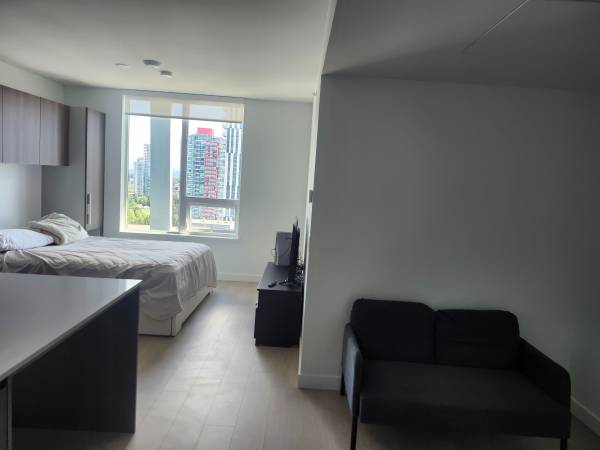
One-bedroom rentals around Metrotown
74 matches as we last checked, confirmed today. This block is rebuilt from the live feed, so it is never the list that was here when the article was written.




Renting a strata unit means two rulebooks apply at once
This is the part people discover in month four. The Residential Tenancy Act governs you and your landlord. The Strata Property Act governs the building, and it reaches you directly: it can fine you, it can charge you the cost of fixing what you broke, it can shut you out of the gym, and in a narrow case it can move to end your tenancy over your landlord's head.
Before renting the unit to you, section 146 of the Strata Property Act requires the landlord to give you two things: the strata's current bylaws and rules, and a Notice of Tenant's Responsibilities in the prescribed form, which everyone calls the Form K. Within two weeks of renting the unit, the landlord must give the strata corporation a copy signed by you.
Landlords skip this constantly, and section 146 attaches a remedy most tenants have never heard of. If the landlord fails to comply, you may end the tenancy agreement without penalty within 90 days of learning of the failure, and the landlord must pay your reasonable moving expenses to a maximum of one month's rent. That is a genuine exit from a strata unit that turned out to have a bylaw you were never shown, and the clock runs from when you found out rather than from when you moved in.
Here is the money side of strata enforcement in one table.
| Rule | What it says | Source |
|---|---|---|
| Maximum fine, bylaw contravention | $200 | Strata Property Regulation s. 7.1 |
| Maximum fine, rule contravention | $50 | SPR s. 7.1 |
| Maximum fine, short-term-accommodation bylaw | $1,000 | SPR s. 7.1 |
| Re-fining a continuing contravention | Every 7 days, except a short-term-accommodation bylaw, which may be fined daily | SPR s. 7.1 |
| The strata must publish its own maximums | In its bylaws, at or below the regulation's ceiling | SPA s. 132 |
| Cost of remedying a contravention | Recoverable from the person who could be fined, on top of the fine | SPA s. 133 |
| Denial of recreational facilities | Permitted, temporarily, for a bylaw or rule contravention | SPA s. 134 |
| Who the strata may collect a tenant's fine from | The tenant, the tenant's landlord and the owner — but not more than the fine in total | SPA s. 131 |
| Required before any fine | A complaint, written particulars given to you, and a reasonable opportunity to answer including a hearing if you request one | SPA s. 135 |
| Move-in or move-out fee | Permitted, must be set out in a bylaw or a ratified rule, and must be reasonable | SPR s. 6.9; Residential Tenancy Regulation s. 7(1)(f) |
Three of those rows do real work.
Section 135 is the one that wins arguments. A fine imposed without a complaint, without written particulars, and without a genuine opportunity to answer is procedurally defective, and the Civil Resolution Tribunal reverses fines on exactly that basis with some regularity. If a $200 charge appears on a notice with no preceding letter, ask in writing for the particulars and the date of the complaint before you pay anything.
Section 131 is the one landlords misunderstand. The strata may pursue you, your landlord and the owner for the same fine, capped at the total, which means it can choose whoever answers the phone. Section 147 lets a landlord assign you some or all of their powers and duties under the Act, the bylaws or the rules — but expressly cannot assign you their section 131 responsibility for fines or for the cost of remedying a contravention. A lease clause making you solely liable for every strata charge, whoever caused it, does not do what it says.
Section 133 is the row that costs the most and gets the least attention. A fine is capped at $200; the cost of remedying the contravention is not capped at anything. A blocked drain traced to your unit, a fob deactivation, a lock re-key, a door damaged during a move — those come back as costs rather than fines, and the ceiling in section 7.1 has nothing to say about them.
On move-in fees, note what is not in that table: there is no dollar cap in the legislation. The regulation requires a user fee to be set out in a bylaw or a ratified rule and to be reasonable, and the Civil Resolution Tribunal has struck down moving fees it found unreasonable. Anyone quoting you a statutory maximum is repeating a rumour. Section 7 of the Residential Tenancy Regulation is a closed list of the non-refundable fees a BC landlord may charge at all. It runs to seven paragraphs: the direct cost of replacing keys and access devices; the direct cost of additional ones you ask for; a bank's returned-cheque charge; an administration fee of not more than $25 for a returned cheque or late rent; a fee capped at the greater of $15 and 3% of monthly rent for moving between units at your own request; a strata's move-in or move-out fee passed through; and a fee for a service or facility you asked for that the tenancy agreement does not require. Section 7(2) adds that the $25 administration fee and the inter-unit move fee may not be charged at all unless the tenancy agreement provides for them. Cleaning fees, pet rent, key deposits above cost and application fees are not on the list at all, and are unenforceable however the lease is worded.
What a strata corporation cannot do to you
The list of prohibitions is shorter than the list of powers, but it covers the things renters are most often bluffed about.
It cannot screen you or approve you. Section 141 says the strata corporation must not screen tenants, establish screening criteria, require the approval of tenants, require the insertion of terms in tenancy agreements, or otherwise restrict the rental of a strata lot. A council demanding your credit report, an interview with the president, or a "tenant application" before you move in is acting outside its authority.
It cannot cap the number of rentals in the building. Sections 142 to 145, which used to permit rental restriction bylaws and set out their exemptions, were repealed outright by section 19 of the Building and Strata Statutes Amendment Act, 2022 — BC Laws carries the annotation "[Repealed 2022-41-19]" against each of them, and rental restriction bylaws in BC stratas have had no force since it came into effect in late 2022. An owner who tells you the building is "at its rental limit" and you may have to leave is describing a bylaw that no longer exists. Age restrictions survived in one narrow shape: section 123.1 says a bylaw must not restrict the age of residents except by requiring a specified age of not less than 55, and section 123.2 exempts anyone already lawfully resident when the bylaw passed and any live-in caregiver. Short-term-accommodation restrictions were left fully intact, which is why a strata can forbid you letting the flat for a fortnight while having no say at all in your living there for six years.
It cannot decide that its own bylaw is valid. Policy Guideline 27 is explicit that the director of the Residential Tenancy Branch has no jurisdiction to determine whether a strata bylaw or rule is legally valid; that question belongs to the Civil Resolution Tribunal. Where a bylaw challenge is live at the tribunal, the director may adjourn a tenancy hearing until it is decided. This matters practically: the forum that can cancel your eviction and the forum that can strike the bylaw behind it are two different bodies, and you may need both.
It cannot evict you for a bylaw breach on its own terms. Section 47(1) of the Act lists twelve grounds for a notice to end tenancy for cause, running from an unpaid deposit through repeated late rent, unreasonable occupant numbers, significant interference, illegal activity, extraordinary damage, unrepaired damage, breach of a material term, an unauthorised sublet, false information given to a viewer, an order of a government authority, and finally non-compliance with an order of the director. None of them is "contravened a strata bylaw." A parking infraction is a fine, not an eviction. Note also how short the clock is on that notice type: section 47(4) gives you ten days to dispute, the tightest window in the Act.
The qualification matters, though, and it is where the two statutes meet. Section 137 of the Strata Property Act says a repeated or continuing contravention of a reasonable and significant bylaw or rule by a tenant is an event that allows the landlord to give notice terminating the tenancy. Section 138 goes further: where the contravention seriously interferes with another person's use and enjoyment of a strata lot, the common property or the common assets, the strata corporation itself may give that notice. Guideline 27 explains the plumbing — the strata becomes a "landlord" under the Act for that one purpose, the notice is issued as a section 47 notice for cause, and the director can cancel it or uphold it and grant an order of possession. Three qualifiers are doing all the work: repeated or continuing, reasonable and significant, and serious interference. A single late-night party does not clear that bar. A year of them might.
The practical instruction is unglamorous. Ask for the current bylaws and rules before you sign, read the sections on pets, parking stalls, storage lockers, bicycles, balcony contents, noise hours, smoking and what may be visible from outside, and understand that they bind you as they stand from time to time — including amendments passed by a three-quarters vote of owners after you moved in, at a meeting you have no right to attend and no vote at. None of those rules appear in your tenancy agreement, and our guide to what belongs in a BC tenancy agreement covers which terms in the agreement itself survive contact with the Act.
The house-form half of the secondary market
The other three secondary-market products are ground-oriented, and they share a landlord profile: one individual, usually living on the same lot or within a few kilometres of it.
| What it is | Usual landlord | Second rulebook | Personal-use eviction available | |
|---|---|---|---|---|
| Secondary suite | A self-contained unit inside someone else's house, almost always below grade | The owner-occupier upstairs | None, but municipal zoning decides whether the unit may exist | Yes |
| Laneway or coach house | A detached unit at the back of the lot, on the lane | The owner of the front house | None | Yes |
| Rented detached house | The whole building, sometimes minus a suite below | One owner | None | Yes |
| Rented strata townhouse or duplex half | A ground-oriented unit in a row or a side-by-side | An individual strata owner | Strata bylaws, Form K, everything in the two sections above | Yes |
Two points are worth carrying forward from that table rather than assuming.
First, the shared-kitchen trap. Section 4(c) of the Act excludes living accommodation in which the tenant shares bathroom or kitchen facilities with the owner of that accommodation. Share a kitchen with the person who owns the house and there is no deposit cap, no rent increase cap, no notice period and no access to the Residential Tenancy Branch. It is a jurisdictional bar rather than a technicality, and it is set out in full in the exclusions section below. A self-contained basement suite with its own kitchen and its own bathroom is fully covered, even where you share the laundry, the driveway, the hot water tank and the front path.
Second, an unpermitted suite is still a tenancy. The Branch's jurisdiction turns on whether a tenancy exists, not on whether the unit satisfies a zoning bylaw, and Guideline 27 treats the owner of a house who rents out a suite they do not occupy as a landlord in the ordinary way. What an unauthorised suite exposes you to is a municipal order to close the unit, which is a risk created by a third party you will never meet, usually triggered by a neighbour's complaint or a permit application on the property. If that order lands, section 47(1)(k) is the ground your landlord will use, and it is one of the twelve grounds for cause rather than a personal-use notice, so no compensation follows.
The full treatment of these three — utilities arithmetic, the code checks you can make on a twenty-minute viewing, yard and snow-clearing obligations, what happens when a house is rented by a group, and how the small-scale multi-unit housing rules have changed what may legally exist on a lot — is in our guide to renting a house, suite or townhouse in Metro Vancouver, and this page deliberately does not repeat it.
Why secondary-market rents behave differently
The $536 gap between a purpose-built two-bedroom and a rented condominium two-bedroom is not mostly about dishwashers. It is about how often the number resets.
BC has rent control within a tenancy and none between tenancies. The increase cap for any increase taking effect in 2026 is 2.3%, down from 3% in 2025. It applies once every twelve months, needs three clear months' notice, and must be served on the RTB's approved form, the RTB-7. Nothing whatsoever limits what a landlord may charge the next tenant after you leave. The method behind the annual number and the running estimate for 2027 sit in our guide to the BC rent increase cap, and that cap is the reference point for every other rent rule on this page.
Now apply it to two buildings. A purpose-built operator holds a unit for decades, sees turnover of maybe a tenth of the building a year, and carries a large book of tenancies whose rent has been compounding at the cap since 2014. An investor-owned condo unit turns over far more often — the owner's plans change, the unit sells, the fixed term ends and a new one is negotiated — and each turnover resets the rent to whatever the market will pay that month. Average the two portfolios and the condo average sits above the purpose-built average by construction, before anyone looks at the finishes. What the CMHC gap mostly shows is the difference between a stock of old tenancies and a stock of new ones.
Three consequences follow, and they are the practical output of this whole half of the page.
A long tenancy is worth more in a condo than in a purpose-built building, and it is less likely to survive. Six years at 2.3% and 3% compounding leaves you well below the asking rent next door. That gap is also the exact size of the incentive for the owner to end the tenancy, and in an investor-owned strata unit section 49(6.1) does not stand in the way.
Fixed terms in this segment are frequently about tax, not about you. A condo owner who insists on a minimum six-month term is often protecting an exemption. The City of Vancouver's Empty Homes Tax and the provincial speculation and vacancy tax both turn on whether the unit was occupied as a principal residence or tenanted for a qualifying part of the year, and both set a minimum tenancy length below which a let does not count. The thresholds are published by the City and by the province respectively and are worth reading in the year you are actually signing, because they are the reason some owners want a longer term than you do. You are being asked for something the owner needs. Price it accordingly.
A fixed term does not end your tenancy. Under section 44(3), where a fixed term ends and the agreement did not require you to vacate on that date, the landlord and tenant are deemed to have renewed as a month-to-month tenancy on the same terms. Back-to-back fixed terms at a new rent each year is an attempt to route around the annual cap, and a vacate clause propping it up is void except in the narrow case prescribed by section 13.1 of the Regulation, which covers an individual landlord whose close family member will occupy the unit. If your condo landlord presents a "renewal" at $250 more in month eleven, the correct answer is that the tenancy continues on its existing terms and any increase must arrive on an RTB-7, three months ahead, once in twelve months, at the cap.
Section 4 is a closed list of eleven exclusions, and three of them are common here
Everything above assumes the Residential Tenancy Act applies. For a large slice of Metro Vancouver's rental stock it does not, and the tenant usually finds out at the point they need it. This table is also a map of the rest of this page: most of the housing types below appear in it.
Section 4 is short, it is not written in code, and it decides whether you have a deposit cap, a notice period, an annual increase limit and a tribunal to go to.
| Housing type | Covered by the RTA? | Authority | What governs instead |
|---|---|---|---|
| Purpose-built rental, rented condo, secondary suite with its own kitchen and bathroom | Yes | s. 2 | The Act, the Regulation, the RTB |
| A unit rented by a not-for-profit co-op to a member | No | s. 4(a) | The occupancy agreement, the co-op's rules, the Cooperative Association Act |
| University or college residence, for its own students or employees | No | s. 4(b) | The residence contract |
| A room where you share a kitchen or bathroom with the owner | No | s. 4(c) | Contract law, Small Claims Court |
| Live-work premises primarily occupied for business, under a single agreement | No | s. 4(d) | Commercial tenancy law |
| Vacation or travel accommodation used as such | No | s. 4(e) | The booking contract — but see the residential hotel section below |
| Emergency shelter or transitional housing | No | s. 4(f) | The programme's own rules |
| Community care, continuing care, hospital or designated mental health facility | No | s. 4(g)(i)–(iv) | Community Care and Assisted Living Act and the rest |
| Accommodation provided in the course of rehabilitative or therapeutic treatment | No | s. 4(g)(vi) | The service agreement |
| A correctional institution | No | s. 4(h) | Correctional legislation |
| A tenancy agreement with a term longer than 20 years | No | s. 4(i) | The lease itself |
| A pad in a manufactured home park | No — but | s. 4(j) | The Manufactured Home Park Tenancy Act |
| Anything else prescribed by regulation | No | s. 4(k) | Whichever regulation prescribed it |
Two of those rows need footnotes. Section 4(k) is the hook the Regulation hangs further exclusions on, and it currently carries two: section 1.2 takes out a tenancy between the government and a tenant arising from a Land Act lease or licence of occupation, and section 1.3 takes out assisted living, covered further down. Section 4(g)(v) was repealed and no longer describes anything.
Three of the eleven describe housing thousands of people in this region live in right now. The room-sharing exclusion in section 4(c) is the one that catches the most people, because it is the standard arrangement in a Point Grey or Dunbar house and nobody mentions it at the viewing. It turns on three things: it is the owner you must be sharing with, not any occupant, so sharing a kitchen with another tenant does not exclude you; it is bathroom or kitchen, not laundry, not entrance, not hallway; and a kitchenette of your own counts as your own kitchen. If you are looking at a room rather than a unit, what you actually get when you rent a room in Vancouver sets out where the line falls.
Two limits apply even when you are comfortably inside the Act, and they belong here because they decide where a claim is heard rather than whether you have one. Under section 58(2)(a) the director cannot decide a claim for debt or damages above the Small Claims monetary limit, currently $35,000. Under section 58(2)(a.1) the director cannot decide a claim above $65,000 under sections 51(1) or (2), 51.1, 51.3 or 51.4 of the Act — the compensation provisions for bad-faith and no-fault evictions — or under sections 44(1), 44(2) and 44.1 of the Manufactured Home Park Tenancy Act. Both figures come from Residential Tenancy Policy Guideline 27, revised July 2024. Above them you abandon the excess under section 58(2.2) and stay at the Branch, or you go to the BC Supreme Court. That matters more than it sounds for twelve-months'-rent compensation claims, which on a $3,000 unit are $36,000 and already over the ordinary ceiling. The mechanics of filing, and what the Branch can and cannot order, are in our guide to the Residential Tenancy Branch.
A second housing system runs alongside the market, and almost none of it is advertised
Everything with a listing page attached to it is one half of the rental stock in this region. The other half — non-profit, co-operative, subsidised, below-market, supportive, institutional — is allocated rather than marketed, and the way you get in has nothing to do with refreshing a search. The rent is set by a formula, the eligibility is tested against your tax return, and in several of these categories the Act either does not apply at all or applies with pieces removed.
That last point is the one worth reading twice. People assume non-market housing means more protection because it is run by a public body or a charity. In several categories it means measurably less.
"Non-market" also describes how the rent is set rather than what the building looks like. A below-market unit can be in a 1970s walk-up run by a church society, in a new concrete tower where a rezoning required it, or in a co-op that has been there since 1982. The physical stock tells you nothing. Three questions do: who operates it, whether your rent is tied to your income, and whether the Act applies.
| Type | Who runs it | How rent is set | Residential Tenancy Act | How you get in |
|---|---|---|---|---|
| Rent-geared-to-income unit | BC Housing, non-profit societies, Metro Vancouver Housing | 30% of gross household income, subject to a minimum | Applies, minus the rent-increase sections and the subletting-consent rule | BC Housing Housing Registry |
| Affordable rental in a non-profit building | Non-profit societies | A fixed rent at or below the CMHC average for that area | Applies in full | Housing Registry, or direct to the provider |
| Market rent unit in a non-profit building | Non-profit societies | CMHC-referenced market rent, with an income ceiling on applicants | Applies in full | Direct application quoting a Housing Registry code |
| Below-market unit in a private building | A private landlord bound by a municipal housing agreement | A formula written into the housing agreement | Applies, but the landlord counts as a public housing body for one purpose | The building's own leasing office |
| Housing co-operative | The members, as a non-profit corporation | A housing charge voted on by the members | Does not apply — s. 4(a) | Each co-op's own waitlist |
| Supportive housing | BC Housing and non-profit operators | Usually the income-assistance shelter rate | Applies, minus ss. 28, 29 and 30(1)(b) | Referral and assessment |
| Transitional housing and emergency shelter | Non-profits on government funding | Varies, often nothing | Does not apply — s. 4(f) | Outreach and referral |
| Assisted living residence | Registered operators, health authorities | A percentage of after-tax income in publicly subsidised beds | Does not apply — Regulation s. 1.3 | Health authority assessment |
| Student residence | The university or college | Set by the institution | Does not apply — s. 4(b) | Institutional application |
Inside one non-profit building there are three rent tiers
BC Housing does not run a single product. It runs three, and a newly completed non-profit building in Burnaby or Surrey will typically contain all three behind the same front door, with three different application forms and three different income tests.
Deep subsidy is rent geared to income at 30% of gross household income, subject to a minimum rent based on household size. The 2026 income limits for the Housing Registry are $24,596 a year for a unit with fewer than two bedrooms and $30,745 for two bedrooms or more. Run the arithmetic and the rents are what you would expect: a single person at the very top of that band pays about $615 a month. This is the tier with the years-long wait, and clearing the income line puts you on a register rather than in a building.
Affordable rental is the middle tier and the one almost nobody knows the name of. Rent is a fixed monthly figure set at or below the CMHC average for the area, not a share of your income, and it is aimed at households with low-to-moderate incomes who do not qualify for deep subsidy. Eligibility here is measured against BC Housing's Housing Income Limits rather than the deep-subsidy numbers above.
Market rent housing is a non-profit unit let at a fixed rent equal to or slightly below the CMHC average, with an income ceiling rather than an income floor: below $84,780 a year for a studio or one-bedroom, below $134,140 for two bedrooms or more, as published on BC Housing's market rent housing page and retrieved on 11 August 2026. You have to demonstrate you can pay it without a subsidy. What you are buying is not a discount so much as a landlord who is a society rather than an asset manager, and a rent set by reference to a survey rather than to what the last applicant offered.
The Housing Income Limits are the number to memorise if you are anywhere near this sector. They are the maximum gross household income for eligibility in a long list of affordable housing programmes, set by area and by unit size rather than by household headcount, published in October 2025 for use effective 1 December 2025:
| Unit size | Housing Income Limit, "Vancouver" area | Source |
|---|---|---|
| 1 bedroom or less | $58,000 | BC Housing HILs, effective 1 Dec 2025 |
| 2 bedroom | $72,000 | BC Housing HILs, effective 1 Dec 2025 |
| 3 bedroom | $86,000 | BC Housing HILs, effective 1 Dec 2025 |
| 4+ bedroom | $107,500 | BC Housing HILs, effective 1 Dec 2025 |
Two things about that table. First, the "Vancouver" HILs area is not the City of Vancouver — BC Housing's own municipal cross-reference puts every Metro Vancouver municipality in it, from West Vancouver to Langley Township, along with Anmore, Belcarra, Bowen Island and Lions Bay. Surrey and Vancouver sit on the same line. Second, $58,000 is not a poverty line. A one-person household at exactly that ceiling, paying CMHC's October 2025 Vancouver CMA one-bedroom average of $1,807, is spending 37% of gross income on rent. Thirty per cent of $58,000 is $1,450 a month, so the gap a subsidised unit closes for that household is roughly $357 monthly. Real money, and less dramatic than most people picture when they hear "subsidised housing".
The rent increase cap does not reach a rent-geared-to-income unit
This is the single most misunderstood rule in the non-market sector, and it is not in the Act — it is in section 2 of the Residential Tenancy Regulation.
Rental units operated by a public housing body listed in section 1(4)(a) to (h) are exempt from four sections of the Act if the rent of the rental units is related to the tenant's income:
- s. 41, rent increases
- s. 42, timing and notice of rent increases
- s. 43, amount of rent increase
- s. 34(2), the landlord's consent to an assignment or sublet
So the 2026 cap of 2.3% does not apply to your rent in a rent-geared-to-income unit. Your rent is 30% of your income and it moves when your income moves, up as well as down, on the annual review, without a three-month notice on an approved form. Get a raise, get a rent increase, and no arbitrator will call it unlawful. That cuts both ways and is the whole point of the model: a job loss cuts the rent in the same month it would otherwise have cut your ability to pay it.
The subletting piece matters just as much and gets noticed later. Section 34(2) is the rule that stops a landlord unreasonably withholding consent to a sublet or an assignment. In an income-tested unit that protection is gone, which means a provider can simply say no, and does, because a sublet defeats the eligibility test the unit was allocated on. If you were planning to be away for four months, read sublet and assignment in BC and then ask your provider in writing before you commit to anything.
The exemption is bounded in a useful way. It bites only where the rent is related to income, so a market rent unit in the same non-profit building is fully covered by sections 41 to 43 and gets the 2.3% cap like any other tenancy. Two neighbours on the same corridor, one capped and one not, distinguished solely by which application form they filled in.
The listed bodies are set out in section 1(4) of the Regulation: BC Housing, CMHC, the City of Vancouver, the City of Vancouver Public Housing Corporation, Metro Vancouver Housing Corporation, the Capital Region Housing Corporation, any housing society or non-profit municipal housing corporation with an operating agreement with the province, BC Housing, CMHC, a municipality or a regional district, and — this is paragraph (h), and it surprises people — any such society whose agreement has expired and was not renewed. The exemption does not lapse when the funding does. Metro Vancouver Housing alone reports about 3,400 affordable rental homes across 50 communities, housing more than 10,000 residents, and has been a non-profit housing provider since 1974.
One-bedrooms under $1,800 in New Westminster
14 matches as we last checked, confirmed today. This block is rebuilt from the live feed, so it is never the list that was here when the article was written.




Section 49.1: the eviction notice that exists only in this sector
Market tenants get evicted for cause, for non-payment, or for the landlord's use of the property. Non-market tenants have a fourth exposure that no market tenant has.
Section 49.1 lets a public housing body end the tenancy of a subsidised rental unit when the tenant, or another occupant, ceases to qualify for the rental unit. A subsidised rental unit for this purpose means one operated by a public housing body, or on behalf of one, and occupied by a tenant who was required to demonstrate that they or another proposed occupant met eligibility criteria related to income, number of occupants, health or other similar criteria before entering into the tenancy agreement. Both limbs have to be present. The mechanics:
| Element | The rule |
|---|---|
| Must be provided for in the tenancy agreement | Yes — s. 49.1(2). If your agreement is silent, the section is not available |
| Earliest effective date | Not earlier than 2 months after the notice is received, and the day before rent is due |
| Fixed term | Cannot end the tenancy earlier than the date specified as the end of the tenancy |
| Earlier date by agreement | Only if the tenant agrees in writing |
| Form | Must comply with s. 52, form and content of a notice to end tenancy |
| Time to dispute | 15 days from receipt, or you are conclusively presumed to have accepted it |
| Compensation | None. Section 51's one month's rent applies to s. 49 notices only |
| Leaving early | s. 50 lets you give 10 days' written notice and pay rent only to that date |
Two months and no compensation is a harsher package than the three months plus one month's rent that comes with a landlord's-use notice under section 49. The dispute window sits between the two extremes in the Act: longer than the ten days you get on a notice for cause, shorter than the twenty-one days prescribed for an occupancy notice and the thirty days that applies to the other section 49 grounds. What "ceases to qualify" means in practice is ordinary life: your income rose past the limit, your household shrank after a child moved out and you are now a single person in a three-bedroom, or the unit was designated for a group you no longer belong to. The general rules on notices, service and disputing are the same ones set out earlier, and the fifteen-day clock is the one to diarise the day the envelope arrives.
Below-market units inside privately owned buildings
The fastest-growing slice of below-market housing in Metro Vancouver is not owned by a non-profit at all. It sits inside privately owned rental buildings, secured by a housing agreement registered against the title.
The legal plumbing is worth understanding because it explains the behaviour. Municipalities can require housing agreements under section 483 of the Local Government Act, or section 565.2 of the Vancouver Charter, as a condition of rezoning. The Residential Tenancy Regulation calls one a specified agreement where its terms both restrict the availability of the unit to certain classes of person identified in the agreement and fix the rent, or the formula for calculating it. In exchange for extra density, a developer secures a block of units at a formula rent for decades.
From a renter's side, three things follow, and the third is the one that trips people up because it points in two directions at once.
These units are advertised, unlike the rest of the sector. They are leased through the building's own office, on the building's own website, alongside the market units. The eligibility test is applied at the leasing office rather than by BC Housing, and it is usually an income ceiling plus proof you do not own residential property. There is no province-wide figure to check the ceiling against, so ask for the number in writing before you apply.
You are income-tested again, every year. A formula rent tied to a class of eligible person implies annual verification. Budget for the possibility that a raise moves you out of the category.
The landlord counts as a public housing body for exactly one purpose. Section 1(4)(i) of the Regulation includes any owner of one or more rental units subject to a specified agreement, which brings section 49.1 into play — two months, no compensation — if you cease to qualify. Section 2(2) confines it: section 49.1 does not reach that owner's units that are not subject to a specified agreement. Same building, same landlord, two different eviction regimes on the same floor. But paragraph (i) sits outside the (a)-to-(h) group that section 2(1) exempts, so the annual rent increase cap and the subletting-consent rule protect you in full. You get the market tenant's rent protection and the subsidised tenant's eviction exposure, in one lease.
Below-market units in new buildings are typically newer, better insulated and closer to SkyTrain than anything a non-profit could acquire at the same price, because they exist as a by-product of tower approvals rather than as a housing programme. Whether one is on offer near you at any given moment is a matter of what has recently completed, which is why they are worth checking for directly at buildings in the growth nodes — Coquitlam and New Westminster have both absorbed a lot of rezoned density this decade.
The other route by which private buildings become non-market is acquisition. The Rental Protection Fund, launched in 2023, capitalises non-profits to buy existing at-risk rental buildings and hold them; on its own published count, retrieved 11 August 2026, it has protected 2,193 homes in 24 BC communities and provided housing security for more than 4,000 British Columbians. If your building is bought by a society, your tenancy continues on the same terms, and the change you notice is that the rent stops chasing the market. Section 93 of the Act is narrower than it is often described: what it moves with the land is the landlord's obligations in respect of your security deposit and pet damage deposit. The tenancy itself continues because the buyer takes the property subject to it, not because section 93 says so, and section 94 stops a court order in a foreclosure or estate proceeding being enforced against you unless you were a party to it.
Co-ops: the best long-run economics, the least legal protection
A housing co-operative is not a landlord and you are not a tenant. You buy a share, which CHF BC puts at $1,000 to $7,000 with a typical purchase around $2,000, and that share makes you a member of a non-profit corporation with a vote. You then pay a monthly housing charge set to cover what the building actually costs rather than what the market will bear. The share is refundable when you withdraw your membership, less damage and any debt to the co-op, so it behaves like a deposit and never appreciates. You are not building equity, which is the whole trade.
Section 4(a) of the Act says it does not apply to living accommodation rented by a not-for-profit housing co-operative to a member of the co-operative. No Residential Tenancy Branch, no deposit rules, no statutory notice periods, no rent cap. Housing charges are voted on by the members at a general meeting, usually on a budget the board proposes, which means an increase can lawfully exceed what a landlord next door could charge — and in practice rarely does, because the people voting are the people paying. What protects you is the occupancy agreement, the co-op's rules and the Cooperative Association Act.
The wording rewards attention: the exclusion covers accommodation rented to a member. If a co-op offers you a unit without membership, ask precisely what your legal status is before signing, because a non-member occupant is in a different position entirely and may well be an ordinary tenant with the full Act behind them.
Getting in is the constraint. There is no central list; each co-op runs its own waitlist, some are closed to applications entirely, and CHF BC's directory filters for the ones that are open. CHF BC puts the wait from applying to even being interviewed at three months to three years or longer, and longer again for a subsidised unit. Subsidy is also not universal: many co-ops hold long-term agreements that bridge the gap to roughly 30% of a low-income member's gross income, but a co-op with no external funding is still cheaper than the market and simply is not means-tested. The full picture, including the provincial Co-op Share Purchase Supplement and the no-interest loan funds for people who cannot raise the share, is in our guide to co-op housing in Vancouver.
Two-bedroom rentals in Burnaby
42 matches as we last checked, confirmed today. This block is rebuilt from the live feed, so it is never the list that was here when the article was written.




Supportive housing, transitional housing and shelter are three different things
They get used interchangeably in conversation and they sit in three different legal places.
Supportive housing is a tenancy, with three sections removed. Section 2.1 of the Regulation defines a supportive housing rental unit precisely, and all four limbs must be met. The unit is in a residential property operated by a listed supportive housing operator — BC Housing, CMHC, a municipality or regional district, a municipal housing corporation, a treaty first nation, a health authority board, a society, a federal not-for-profit corporation or a registered charity. The tenant was assessed, on criteria the operator sets, as experiencing or at risk of homelessness and as someone who would benefit from housing stability support. That support is available to at least one tenant of the unit. And the unit is not provided on a temporary basis.
The support itself has its own four-part test: it must be available on the premises, provided by a support worker employed by the operator, voluntary to receive, funded at least in part by the operator or by BC or Canada, and of at least one defined type — social and recreational participation intended to promote community inclusion, skills training aimed at independent living, collaborative planning and goal-setting with follow-up, or referrals and regularly-available help accessing community resources and non-acute health services.
Where all of that is met, the unit is exempt from section 28, the tenant's right to quiet enjoyment; section 29, the restriction on the landlord entering; and section 30(1)(b), the tenant's right of access. Staff can enter without the 24 hours' written notice that governs every other tenancy, and guest access can be controlled. Everything else in the Act — deposits, rent, notice to end tenancy, dispute resolution — still applies. Rent in these buildings is typically pegged to the income-assistance shelter allowance, which has had a maximum of $500 a month for a single person since 1 August 2023, alongside a $560 support allowance. Against CMHC's October 2025 studio average of $1,667 for the Vancouver CMA, the shelter rate covers 30% of an average studio, which is the arithmetic behind the whole sector.
Transitional housing is not a tenancy at all. Section 4(f) excludes it, and Regulation section 1(2) defines it as accommodation provided on a temporary basis, by a person or organisation funded by a local government or the government of British Columbia or of Canada for the purpose of providing that accommodation, together with programmes intended to assist tenants to become better able to live independently. All three limbs have to be present, and a provider calling a building transitional does not make it so. Emergency shelter is excluded by the same paragraph.
Single-room-occupancy hotel rooms, the older privately owned stock concentrated in the Downtown Eastside, are ordinary tenancies. Unless a room meets the supportive-housing definition above or the building is genuinely run as transitional housing, the full Act applies: deposit caps, notice periods, the rent increase cap, the lot. Whether a given SRO is privately run, non-profit run or leased by BC Housing changes the answer, and it is a question worth asking before you assume which regime you are in.
Seniors' housing: independent living is a tenancy, assisted living stopped being one
Three products get sold to older renters and only one of them is a tenancy.
Independent living is a normal rental apartment in a building aimed at seniors, sometimes with optional meals or housekeeping sold separately. It is a tenancy, fully covered by the Act, and BC Housing runs a Seniors' Rental Housing stream with its own income limit; that limit is set by area and is published on the programme page, so check it against the area you are applying in rather than against the general Housing Income Limits above.
Assisted living is not a tenancy, and this changed recently enough that most people have not caught up. Section 1.3 of the Residential Tenancy Regulation says the Act does not apply to a rental unit in an assisted living residence that is occupied by a resident, with "assisted living residence" and "resident" carrying their meanings from section 1 of the Community Care and Assisted Living Act. The one thing that survives is a dispute about a matter that arose before 23 February 2026: for those, an application for dispute resolution may still be made and the Act still applies. After that date the Residential Tenancy Branch is not the forum, and the Assisted Living Registrar is. In a publicly subsidised assisted living bed the monthly rate is not a market rent at all — it is calculated as a fixed percentage of the resident's after-tax income as defined in the Continuing Care Fees Regulation, subject to minimum and maximum monthly rates that vary by area and are set in the provincial Home and Community Care Policy Manual. Ask the health authority for the current percentage and the applicable minimum and maximum in writing, because those are the numbers that decide the bill and they are not published on the residence's own brochure.
Long-term care was never a tenancy. Section 4(g) excludes living accommodation in a community care facility, a continuing care facility, a public or private hospital, a designated mental health facility, and accommodation made available in the course of providing rehabilitative or therapeutic treatment or services.
The practical consequence for a family comparing buildings: the day a parent moves from the independent living wing to the assisted living wing of the same building, the legal protections change entirely, the tribunal changes, and nobody at the front desk is obliged to mention it.
Student housing is a contract, not a tenancy
Section 4(b) excludes living accommodation owned or operated by an educational institution and provided by that institution to its students or employees. A room in a residence at UBC, SFU, Langara, BCIT, Douglas or Capilano is governed by the residence contract and by the institution's own appeals process. No deposit cap, no statutory notice period, no route to the Residential Tenancy Branch. The contract is the whole of your position, and it can be ended on the terms written into it.
The supply arithmetic is why so few students are in that position anyway. UBC Vancouver had 13,883 student housing beds as of August 2024 against 62,115 students enrolled at that campus in 2025/26 — roughly one bed for every 4.5 students, our arithmetic on two figures published a year apart, and beds are counted per bed while enrolment is a headcount including part-time students. CMHC recorded 1.3% vacancy in purpose-built rental in the University Endowment Lands zone in October 2025, against 3.7% across the Vancouver CMA, in a zone containing only 2,082 purpose-built units. Student residences are excluded from that survey by design, so the zone number describes what students actually compete for.
Where residence wins is price. A single room at Totem Park on the 2026/27 Winter Session contract, 5 September 2026 to 28 April 2027, costs $15,647.32 including the mandatory meal plan, internet and utilities. Eight months of a one-bedroom at the October 2025 University Endowment Lands average of $2,469 is $19,752 before food, hydro, internet or insurance.
Where it loses is length, and the mismatch is structural. A Winter Session contract runs about eight months; a private tenancy in BC runs twelve months fixed or month-to-month, and a fixed term that ends without a mutual agreement to vacate continues month-to-month rather than stopping. That gap is the single biggest source of avoidable cost in a student housing year, and our full treatment of student housing in Metro Vancouver works through the two ways out of it campus by campus.
Two edges are worth knowing. Policy Guideline 27 says that where an educational institution provides accommodation to individuals other than its students or employees, the Act may apply — so summer lets of residence rooms to the general public are not automatically outside the Act the way a September-to-April student contract is. And institution-affiliated housing that is not owned or operated by the institution, such as a purpose-built student building run by a private operator near a campus, falls outside section 4(b) altogether and is a normal tenancy. Read who the landlord actually is on the agreement rather than who the marketing says the building is for.
Manufactured home pads: you own the house and rent the ground
A manufactured home site is the one rental type in this region where the tenant owns the dwelling. You buy the home, you rent the pad it sits on, and section 4(j) hands the whole arrangement to the Manufactured Home Park Tenancy Act instead of the Act discussed everywhere else on this page. Parks in Metro Vancouver cluster in Langley, Maple Ridge, Delta, Surrey, Richmond and Coquitlam — the parts of the region where land was cheap enough in 1975 to make the model work, and expensive enough now to make redevelopment attractive.
Three rules do most of the work.
Pad rent increases are not capped at 2.3%. Section 32 of the Manufactured Home Park Tenancy Regulation sets the maximum as the inflation rate plus a proportional amount. The inflation rate is the same 12-month average percent change in the all-items BC Consumer Price Index that produced the 2.3% residential figure for 2026. The proportional amount is the sum of the change in local government levies and the change in utility fees, divided by the number of manufactured home sites in the park. So a lawful pad increase can exceed what a landlord next door could charge an apartment tenant, and the excess is arithmetic rather than discretion. Ask to see the levy and utility figures the number is built from.
Park closure runs on a twelve-month notice and a fixed cheque. Under section 42 of the MHPTA, a landlord who has all the necessary permits and approvals and intends in good faith to convert all or a significant part of the park to a non-residential use, or to a residential use other than a manufactured home park, may end the tenancy on a date at least 12 months after the notice is received. You have 15 days to dispute it. Section 44(1) requires compensation on or before the effective date, and section 33.1 of the Regulation prescribes the amount: $20,000. Section 43 lets you leave early on ten days' written notice with rent prorated, and expressly says doing so does not affect your right to the compensation.
If the stated conversion never happens, the second payment is larger. Section 44(2) plus Regulation section 33.1 sets it at the greater of $5,000 and twelve months' rent, payable where steps have not been taken to accomplish the stated purpose within a reasonable period. On a pad rent of $900 that is $10,800, so the $5,000 floor only binds on the very cheapest sites. The director may excuse the landlord where extenuating circumstances prevented it. And there is a third payment almost nobody knows about: section 44.1 lets you apply for compensation equal to the amount by which your home's most recent assessed value exceeds the prescribed $20,000, where the home is not capable of being moved before you have to vacate. On a home assessed at $95,000 that is a materially different conversation, and it is why the $65,000 ceiling noted in the exclusions section above is worth remembering — pad claims sit under it and stay in front of the Branch rather than going to the Supreme Court.
Two definitional traps. The MHPTA's definition of "tenancy agreement" covers an agreement respecting possession of a manufactured home site and does not include a licence to occupy, where the Act's definition expressly does. An arrangement drafted as a licence in a park can therefore fall between the two statutes. And a float home is not a manufactured home, so the MHPTA does not apply to it at all — though Policy Guideline 27 is explicit that renting a float home, a travel trailer or a recreational vehicle can be an ordinary tenancy under the Act. Its own example is a float home let on a six-month fixed term.
When the land is not the province's to govern
Provincial tenancy law stops at the edge of federal jurisdiction, and Metro Vancouver has more of that edge than most regions.
Reserve lands. Under section 91(24) of the Constitution Act, 1867 the federal government has exclusive authority over reserve lands. The BC Court of Appeal has held that the MHPTA does not apply to tenancies on reserve lands, and Guideline 27 says the same analysis should apply to the Act — see Sechelt Indian Band v. British Columbia (Manufactured Home Park Tenancy Act, Dispute Resolution Officer), 2013 BCCA 262, and McCaleb v. Rose, 2017 BCCA 318. Some Nations have made their own law in the space: Westbank First Nation's self-government agreement puts its lands squarely under section 91(24), and the WFN Residential Premises Law governs tenancies there.
There is one narrow exception in this region. In 2023 the federal government made the Squamish Nation Residential Tenancy Regulations under the First Nations Commercial and Industrial Development Act, applying the Act and the MHPTA to specific rental units and manufactured home sites on Squamish Nation reserve lands, with a tripartite agreement between the Nation, BC and Canada for the director to exercise their powers. The Regulations name five locations: 100 Khatsilano Road, 189 Mathias Road, 191 Mathias Road and 239 Capilano Road in West Vancouver, and 41139 Government Road in Squamish. The list is addresses, not a blanket. Sen̓áḵw, the all-rental development at the foot of the Burrard Street Bridge on Squamish Nation land, is not on it. That is not a warning about any landlord — it is a statement about which dispute process you would be using, and the honest answer is to ask the operator, in writing, before signing: which tenancy law governs this agreement, and where is a dispute heard?
Treaty lands are different from reserve lands and the answer varies by Nation. Lands held under a modern treaty are not reserve lands, so the question is one of treaty terms and the Nation's own laws rather than the constitution. The Branch applies the Act and the MHPTA without modification on Tsawwassen treaty lands, which are inside Metro Vancouver, and on Nisg̱a'a, Uchucklesaht and Yuułuʔiłʔatḥ lands. It applies them with modifications made by the Nation on Toquaht, Huu-ay-aht and Ka:'yu:'k't'h'/Che:k'tles7et'h' lands. It does not apply them on Tla'amin lands, where the Tla'amin Residential Tenancy Law prevails and gives the director no authority to hear disputes. All of that is from Guideline 27.
Military housing administered by the Canadian Forces Housing Agency falls under federal authority over the military and defence in section 91(7), and the CFHA runs its own dispute resolution service.
Hotels, residential hotels and the thing you can do about it
Section 4(e) excludes vacation or travel accommodation being used for vacation or travel purposes. It does not exclude a room in a building that calls itself a hotel where somebody actually lives, and Guideline 27's own example of where the Act would likely apply is a winter chalet let on a six-month fixed term.
The guideline sets out four factors: whether the agreement to rent the accommodation is for a term, whether the occupant has exclusive possession of the dwelling unit, whether the unit is the occupant's primary and permanent residence, and the length of occupancy. It then says the quiet part directly — a tenancy agreement may exist even where the room is operated under the Hotel Keepers Act, even where hotel room tax is charged, and even where the occupant pays a daily rate. Written or oral.
And there is a remedy specific to this situation that almost nobody uses: a person occupying a room in a residential hotel may make an application for dispute resolution without notice to any other party, requesting an interim order that the Act applies to that living accommodation. If you have been living in an SRO or a residential hotel for months on a nightly rate and are told the tenancy rules do not reach you, that application is how you test it, and it is filed the same way as any other.
The same four factors govern the other end of the market. A furnished, all-in, thirty-day-minimum unit is either a tenancy or a licence depending on term, exclusivity and permanence, not on what the listing calls itself — which is why furnished and short-term rentals in Metro Vancouver is worth reading before signing anything that describes you as a "guest".
The commercial exclusion in section 4(d) works on a similar logic in reverse. Live-work premises are outside the Act where they are primarily occupied for business purposes and rented under a single agreement, and Guideline 27 notes the law has moved away from looking only at present use toward the terms of the agreement, the zoning, the development permits and local government policy. A tenant cannot unilaterally change the essential nature of a tenancy by using the unit differently, and neither can a landlord.
One-bedrooms at the lower end of the Surrey market
208 matches as we last checked, confirmed today. This block is rebuilt from the live feed, so it is never the list that was here when the article was written.


Applying to the non-market queues is a background process, not a plan
None of these queues talk to each other, and applying to one does not cost you a place in another.
One Housing Registry application puts you in front of many non-profit and co-operative providers at once for the subsidised tier. It is not a numbered queue and nobody can give you a date.
Affordable and market rent units in non-profit buildings take separate applications, quoting a Housing Registry code from BC Housing's housing listings. These move far faster than the deep-subsidy queue and are the tier most people in the $58,000-to-$85,000 band should be applying for, and almost nobody does, because the deep-subsidy wait is the only part of the sector that gets written about.
Below-market units in private buildings are applied for at the building, one at a time, as they complete. Nobody maintains a regional list of them.
Co-ops each run their own waitlist, and some are not accepting applications at all.
Three cash programmes sit outside all of that and attach to you rather than to a building, which means they pay while you rent privately and they pay in weeks rather than years. The Rental Assistance Program requires a dependent child and caps gross household income at $60,000. SAFER requires you to be 60, caps gross monthly household income at $3,333.34, and disqualifies you outright if you live in subsidised housing. The Canada-BC Housing Benefit covers the gap those two leave — a single person or couple under 60 with no dependent child — but providers select applicants rather than taking public applications, so it needs a referral from an agency already working with you. Which of the four you qualify for is worked through in our guide to subsidised housing and rent help in BC.
Take the applications seriously and then forget about them. Non-market housing is something you enter years after you apply, and until then the rent you pay is the market rent, quoted in full, with any assistance arriving separately and afterwards. Budget against the rent, not against the rent minus an approval you do not have.
Matching the type to the situation
| Your situation | The type that usually fits | The trap |
|---|---|---|
| Under six months in the region | Furnished, or a room | A tenancy agreement is not automatic; check term, exclusivity and permanence |
| Undergraduate, first year | Residence | Eight-month contract, no protection under the Act, no guarantee past first year |
| Undergraduate, upper year | Private unit near a frequent transit route | Allocation for on-campus is random and waitlist offers run into August |
| Newly arrived, want the fewest surprises | Purpose-built rental | Older stock, fewer amenities, and the cheapest rents go to the longest tenancies |
| Want the new building and the dishwasher | Rented condo | Two rulebooks, and s. 49(6.1) does not protect you however large the tower |
| Household income under $31,000 | Housing Registry, plus a market search running in parallel | The Registry is not a queue with a number, and s. 49.1 applies once you are in |
| Household income $58,000 to $85,000 | Affordable and market rent units in non-profit buildings | Separate application per building; the Registry code is not the application |
| 60 or over, renting privately | SAFER cash while staying in the market | Living in subsidised housing disqualifies you outright |
| Stable, long horizon, willing to attend meetings | Co-op | No Act, no rent cap, and a wait measured in years |
| Own a manufactured home | A pad, in a park not zoned for imminent redevelopment | Increases exceed 2.3% lawfully; conversion pays $20,000 and takes your neighbours too |
| Sharing with the person on title | Nothing, legally | Section 4(c) removes the Act entirely |
Five questions to ask before you sign, whatever the type
The failure mode across every category above is the same: people work out the rent, the commute and the pet policy, and never establish which legal regime they are entering. Five questions settle it, and all five can be asked by email before any money moves.
Who owns the accommodation, and do I share a kitchen or bathroom with them? This is section 4(c), and it is the single largest exclusion from the Act in the region's housing stock.
Is this a tenancy agreement, a residence contract, an occupancy agreement, or a licence? The word on the document is not decisive, but the answer tells you who thinks what, and a landlord who will not answer in writing has told you something.
Is my rent related to my income, and is the operator a public housing body? If both are yes, the annual increase cap does not apply to you and section 49.1 does. That is not a reason to refuse the unit. It is a reason to know.
What land is the building on? Reserve, treaty or fee simple. The answer changes which tribunal hears a dispute, or whether there is one.
Where does a dispute go? The Branch, the co-op's internal process, the institution's appeals office, the Civil Resolution Tribunal, Small Claims, or a Nation's own tenancy law. Get the name of the forum before you need it.
Figures on this page are current to 11 August 2026: the 2026 rent increase cap of 2.3%, the 2026 Housing Registry income limits, BC Housing's Housing Income Limits effective 1 December 2025, CMHC's October 2025 Rental Market Survey published 11 December 2025, UBC's published 2026/27 residence fees, and Residential Tenancy Policy Guideline 27 as revised July 2024. Statutory amounts — the $20,000 park conversion compensation, the $35,000 and $65,000 monetary limits, the $200 and $50 strata fine ceilings, the co-op share range — sit in regulation and guideline rather than in a market, so they move rarely and without notice. Check the source links against anything you are about to rely on. None of this is legal advice; the Residential Tenancy Branch takes calls at 1-800-665-8779, the Civil Resolution Tribunal handles strata bylaw disputes, and the Tenant Resource and Advisory Centre runs a free tenant infoline for the situations where the answer above is "the Act does not apply to you."
If you have worked out which type you are in, our plain-English walk through the Residential Tenancy Act covers the rules that apply once you are inside it, section by section.
Keep reading
The rest of what we have written about renting here.
Renting in Vancouver
Where to Rent in Metro Vancouver
Every Metro Vancouver survey zone compared on rent, fare zone, commute time, building age and vacancy, with the trade-offs the averages quietly hide.
Renting in Vancouver
Affordable Housing in Metro Vancouver
Eleven routes to below-market rent in Metro Vancouver, ranked by how many households each one reaches and how long the wait runs, with every income test.
Renting in Vancouver
Furnished, Short-Term and Month-to-Month Rentals in Metro Vancouver
Ninety days puts your stay outside BC's short-term rental law, 27 days ends the accommodation tax and one month ends the GST. What each threshold costs you.
Tenancy law
The BC Tenancy Agreement, Clause by Clause
A clause-by-clause walkthrough of BC's tenancy agreement, form RTB-1: what each clause commits you to, which blanks matter, and which added terms are void.
Money
Co-op Housing in Vancouver: What It Costs, and What You Give Up
A share is $1,000 to $7,000 and refundable. The waitlist runs three months to three years. And the Residential Tenancy Act does not protect you at all.
Money
Commuting to UBC: What Every Option Costs
Every way to reach UBC, priced: U-Pass at $47.85 a month, Evo at $0.49 a minute, a $1,153.93 parking permit, plus scheduled bus times from ten places.