Renting in Vancouver
Every SkyTrain Station, With the Rent and the Fare Zone
All 54 SkyTrain stations with the fare zone, the CMHC rent average and the ride to Waterfront, plus what the monthly pass really costs a renter.
Updated 2026-08-12 · 56 min read
There is no published rent figure for a SkyTrain station. There is a published rent figure for a CMHC survey zone, a published fare for a TransLink zone, and a published ride time for a handful of station pairs, and the three of them are drawn on three different maps that do not line up. This page puts all 54 stations into one table anyway, because the alternative — choosing a station on the strength of a listing that says "steps to SkyTrain" — is how people end up paying $474 a year in fares to save two minutes.
The short version of the argument, before the tables. The fare-zone premium between Zone 1 and Zone 3 is $94.45 a month, and it disappears entirely for students, for concession riders, for anyone commuting by bus, and for anyone whose trips mostly start after 6:30 p.m. The rent spread across the region is $1,043 a month on a one-bedroom. Fare zone is the smallest of the three numbers attached to an address. It is simply the one that is easiest to look up.
Everything below is dated and attributed. Fares are TransLink's, effective 1 July 2026. Service frequencies and spans are TransLink's published schedules, checked 11 August 2026. Rents and vacancy are CMHC's Rental Market Survey for October 2025, published 11 December 2025, and cover occupied purpose-built rental apartments only. Statute is quoted from BC Laws.
The network is three rail lines, a boat and a commuter train
Metro Vancouver's rapid transit network is 54 stations and 79.6 km of track. The last extension opened on 2 December 2016, when the Evergreen Extension reached Lafarge Lake–Douglas; the only addition since is Capstan, an infill station on the Canada Line in Richmond, which opened for passengers on 20 December 2024.
| Service | Opened | Stations | Peak headway | Fare zones crossed | Termini |
|---|---|---|---|---|---|
| Expo Line | 11 Dec 1985 | 24 | 2–5 min | 1, 2 and 3 | Waterfront – King George; Waterfront – Production Way–University |
| Millennium Line | 7 Jan 2002 | 17 | 3–4 min | 1 and 2 | VCC–Clark – Lafarge Lake–Douglas |
| Canada Line | 17 Aug 2009 | 17 | 6 min per branch | 1 and 2 | Waterfront – Richmond–Brighouse; Waterfront – YVR–Airport |
| SeaBus | 17 Jun 1977 | 2 | 10 min | 1 and 2 | Waterfront – Lonsdale Quay |
| West Coast Express | 1995 | 8 | 5 trains each way, weekdays only | its own 5 zones | Waterfront – Mission City |
Source: TransLink service information and schedules, checked 11 August 2026.
Those counts overlap. The Expo Line's 24 stations are 20 between Waterfront and King George plus four more on the branch that leaves Columbia and runs through Sapperton, Braid and Lougheed Town Centre to Production Way–University. Four stations are served by two lines — Waterfront, Commercial–Broadway, Lougheed Town Centre and Production Way–University — which is how 24 plus 17 plus 17 comes to 54 distinct places to live near rather than 58.
Waterfront is the only station where the Expo Line, the Canada Line, the SeaBus and the West Coast Express all meet, and it is the reference point for almost every commute time published in this region, including ours. Commercial–Broadway is the other structural station: it is where the Expo and Millennium lines cross, and until the Broadway Subway opens it is the compulsory transfer for every Millennium Line rider heading downtown. A station's value to you is largely a question of which of those two it connects to without a change.
The Canada Line is the odd one out, and it matters at 8 a.m. Its platforms are shorter than the Expo and Millennium lines' and its peak headway on each branch is six minutes against two to five, so it carries fewer trains with fewer cars on them. A six-minute service that is full at Marine Drive behaves differently from a three-minute service that is full at Brentwood, because on the three-minute service the next train is three minutes away.
The three fare zones cut the map in four places
The fare zone is the second price tag on every address in this guide, and the boundaries are not where most people put them. Zone 1 is the City of Vancouver plus the UBC campus and the University Endowment Lands. Zone 2 is Burnaby, New Westminster, Richmond, the North Shore, Port Moody and Coquitlam. Zone 3 is everything south of the Fraser — Surrey, Delta, White Rock and Langley.
On rail, that produces exactly four boundaries:
- Expo Line, Zone 1 to Zone 2: between Joyce–Collingwood and Patterson.
- Expo Line, Zone 2 to Zone 3: between Columbia and Scott Road, crossing the Fraser.
- Millennium Line, Zone 1 to Zone 2: between Rupert and Gilmore, crossing Boundary Road. Every station from Gilmore east — Brentwood Town Centre, Holdom, Lougheed, and the whole Evergreen Extension out to Lafarge Lake–Douglas — is Zone 2, not Zone 3.
- Canada Line, Zone 1 to Zone 2: between Marine Drive and Bridgeport, crossing the North Arm of the Fraser.
The SeaBus crosses Burrard Inlet, which is the Zone 1/Zone 2 line, so a weekday-morning crossing is always a two-zone fare. The West Coast Express ignores the three-zone system entirely and runs on five zones of its own.
The Evergreen Extension is the fact renters and, in our experience, a fair number of leasing agents get wrong. Coquitlam feels far, so people assume Lafarge Lake–Douglas must be Zone 3. It is not. There is no rail station anywhere on the network in Zone 3 except the four in Surrey.
Two rules switch the zones off, and they are worth more to a renter than any of the arithmetic that follows. Every bus trip is a one-zone fare at all times, whatever the distance. And every trip beginning after 6:30 p.m. on a weekday, or at any time on a Saturday, Sunday or statutory holiday, is charged as one zone. Zones only bite on weekday-daytime SkyTrain, SeaBus and West Coast Express travel. Evening shifts, weekend work and a Sunday spent looking at flats in Richmond all cost the same wherever you sleep.
The bus rule has a second-order effect that almost nobody prices in. Because the rail fare is counted from the station where you tap onto the train, a bus leg to a station in a cheaper zone is charged at one zone and does not add to the rail count. A rider living near Scott Road who buses across the Pattullo and boards at New Westminster is making a two-zone trip, not a three-zone one — $4.20 rather than $5.40, or a $156.70 pass rather than a $211.65 one. It costs fifteen to twenty minutes each way, which is the trade, and it is the single largest fare lever available to anyone living south of the Fraser.
What a trip costs, effective 1 July 2026
TransLink raised fares an average of 5% on 1 July 2026. Every fare quoted anywhere on this page comes from this table.
| Fare | 1 zone | 2 zones | 3 zones | Source |
|---|---|---|---|---|
| Compass stored value, adult | $2.85 | $4.20 | $5.40 | TransLink, 1 July 2026 |
| Cash or contactless, adult | $3.50 | $5.10 | $6.70 | TransLink, 1 July 2026 |
| Monthly pass, adult | $117.20 | $156.70 | $211.65 | TransLink, 1 July 2026 |
| Stored value, concession | $2.30 | $3.40 | $4.60 | TransLink, 1 July 2026 |
| Monthly pass, concession | $66.95 (all zones) | — | — | TransLink, 1 July 2026 |
| DayPass, adult | $12.55 (all zones) | — | — | TransLink, 1 July 2026 |
| DayPass, concession | $9.75 (all zones) | — | — | TransLink, 1 July 2026 |
| YVR AddFare | $6.50, added to any trip starting at YVR–Airport, Sea Island Centre or Templeton | TransLink, 1 July 2026 |
Concession covers seniors 65 and over, youth aged 13 to 18 and HandyCard holders. Children 12 and under travel free. Transfers run 90 minutes across bus, SeaBus and SkyTrain, and 120 minutes where the West Coast Express is involved.
Read the concession row against the adult one for a moment, because it inverts the whole page for a large group of renters. A concession monthly pass is $66.95 for all three zones — less than an adult one-zone pass. For a renter over 65, the fare zone is not a reason to stay close in, and neither is it a reason to move out.
Cash is a penalty of 65 cents to $1.30 a trip depending on zone, which is $280 to $560 a year for a five-day commuter who never got round to buying a card. The fare-gate system is called Compass, and because the card is the part of it people touch, it is also what most of this region calls the fare system as a whole. The card carries a $6 refundable deposit and is sold online, at vending machines in every station, at retailers and at the customer service centre inside Waterfront.
Two mechanical details are worth knowing before you buy anything. A monthly pass is a calendar-month product, not a rolling thirty days: passes can be pre-purchased from the 20th of the preceding month and activated up to the 15th, and a pass bought and tapped after the 15th applies to the following month. So a lease starting 1 October and a pass bought on 18 September are already aligned, and a pass bought on 18 October is not.
The DayPass is the one to reach for on a viewing day, with a caveat. At $12.55 it beats stored value above about 4.4 taps in Zone 1, 3 taps across two zones and 2.3 across three. But a Saturday of viewings is one-zone all day whatever the geography, so the same day of five stops costs $14.25 on stored value against $12.55 on a DayPass — a saving of $1.70, not the $20 people imagine. Book viewings on a weekday morning and the arithmetic reverses sharply in the DayPass's favour.
Pass, stored value, or neither: the break-even nobody runs
The monthly pass is oversold, and the reason is that most rent-versus-commute comparisons — including some of the tables further down this page — quote the pass as the cost of a distant address. For a large share of renters it overstates the number, because the pass is only worth buying at close to a full five-day week.
| Pass | Price | Stored value fare | Taps to break even | Office days at 2 taps | Source |
|---|---|---|---|---|---|
| 1 zone | $117.20 | $2.85 | 41.1 | 20.6 | TransLink, 1 July 2026 |
| 2 zones | $156.70 | $4.20 | 37.3 | 18.7 | TransLink, 1 July 2026 |
| 3 zones | $211.65 | $5.40 | 39.2 | 19.6 | TransLink, 1 July 2026 |
A month averages about 21.7 working days, so a five-day-a-week commuter makes roughly 43.4 taps and the pass wins in every zone — by $6.49 in one zone, $25.58 in two and $22.71 in three. Those are not large margins. Drop to four office days a week, around 34.7 taps, and the pass loses: stored value comes to $98.90, $145.74 and $187.38 against pass prices of $117.20, $156.70 and $211.65, so buying the pass costs you $18.30, $10.96 or $24.27 for nothing. Drop to three days, around 26 taps, and stored value costs $74.10, $109.20 and $140.40 — saving a three-zone commuter $71.25 a month against the pass.
Then apply the time-of-day rule. A five-day Surrey commuter who reliably leaves the office after 6:30 p.m. pays $5.40 going in and $2.85 coming home — $8.25 a day, $179.03 a month — and saves $32.62 by not buying the three-zone pass at all. A renter whose work and errands are local, on buses, never touches the zone premium in the first place.
That single fact has done more to change where it is rational to live in this region than any transit project since 2016. The fare penalty for a distant address was always the pass, and hybrid work removed the pass from a large share of commuters. A schedule of two or three office days makes the far end of the Expo Line and the Evergreen Extension rational in a way it simply was not in 2019, with no change to rent, service or geography. So decide the number of office days first and the station second. What your income supports, before you start ranking stations by it at all, is worked through in how much rent you can afford in Vancouver.
Where the rent data comes from, and what it cannot tell you
The closest thing to a station-area rent figure is CMHC's Rental Market Survey, taken in October 2025 and published 11 December 2025. Several of its zones are effectively station districts. Mapping each line onto the zones it runs through gives the only honest station-area rent picture available:
| Line | CMHC survey zones it runs through | 1-bed average, low to high | Fare zones |
|---|---|---|---|
| Expo | Downtown, East Hastings, Central Park/Metrotown, Southeast Burnaby, New Westminster, North Burnaby, Surrey | $1,564 – $2,112 | 1, 2, 3 |
| Canada | Downtown, Mount Pleasant, South Granville/Oak, Westside/Kerrisdale, Marpole, Richmond | $1,494 – $2,112 | 1, 2 |
| Millennium | Mount Pleasant/Renfrew Heights, East Hastings, North Burnaby, Tri-Cities | $1,692 – $1,710 | 1, 2 |
| SeaBus | Downtown, North Vancouver (City) | $1,918 – $2,112 | 1, 2 |
| West Coast Express | Downtown, Tri-Cities, Maple Ridge/Pitt Meadows | $1,426 – $2,112 | own 5 |
Source: CMHC Rental Market Survey, October 2025, published 11 December 2025. CMA one-bedroom average $1,807; studio $1,667; two-bedroom $2,364.
Three warnings attach to every rent figure on this page, and they are stated here once rather than repeated under each line.
The survey covers occupied purpose-built rental only. That means sitting tenancies, including ones signed in 2015 that have only ever had the annual capped increase applied. Asking rents on new leases are a separate series: Rentals.ca and Urbanation put the City of Vancouver one-bedroom asking rent at $2,377 in July 2026 against CMHC's $1,807 for the whole metropolitan area. Use the survey to rank stations against each other and asking rents to write a budget, a distinction our guide to what the average rent figures actually measure sets out in full.
The towers at the stations are mostly not in the survey. The clusters around Brentwood, Metrotown, Lougheed, Richmond City Centre, Marine Drive and Lower Lonsdale are overwhelmingly rented condominiums rather than purpose-built rental, and CMHC surveys those separately: 1.5% vacancy across the metropolitan area, and a two-bedroom average of $2,900 against $2,364 in purpose-built buildings. That is roughly a 23% premium, from an individual owner who can end the tenancy to move a family member in. A station district's purpose-built average and the rent you will actually be quoted at that station can be $500 apart for that reason alone. Which of the two you are looking at changes the risk of the tenancy rather than only its price, and the difference between the building types is the subject of our guide to the types of rental housing in Metro Vancouver.
The headline vacancy rate does not describe your budget. Overall purpose-built vacancy was 3.7% in October 2025, the highest since 1988, but split by price it was 1.1% in the cheapest quarter of units, 2.2% in the second, 5.0% in the third and 6.7% in the dearest. All of the slack is at the top. A renter searching under about $1,700 near a station is searching a 1% market whatever the headline rate says, which is worth knowing before you decide how flexible you can afford to be about which station.
Frequency and span decide more than distance does
Ride time is the number every listing quotes and it is the least reliable part of a commute. What actually determines whether a station works is how long you wait for the train and how late it runs.
Peak headways as scheduled for 8 June to 6 September 2026 are two to five minutes on the Expo Line, three to four on the Millennium Line and six on each Canada Line branch. Off-peak and late evening they lengthen considerably on all three. Service span on a weekday runs from a first eastbound Expo Line train leaving Waterfront at 5:29 a.m. to a last one at 1:16 a.m.; the Millennium Line's first eastbound from VCC–Clark is 5:30 a.m. and its last is about 1:22 a.m.; the Canada Line's first train to the airport is 4:48 a.m., its last is 1:08 a.m., and to Richmond–Brighouse the first is 5:33 a.m. and the last 1:15 a.m.
There is no overnight rail service of any kind. If your shift ends at 1 a.m. anywhere in this region, look up the specific last train from the specific station before you sign, because the difference between finishing at 12:45 and finishing at 1:30 is the difference between a fifteen-minute ride home and a NightBus with a 30-minute headway. The last eastbound and the last westbound train from the same station are not the same time either.
Add the walk and the wait to every station figure you read. Median scheduled in-vehicle time from Metrotown to Waterfront is 19 minutes, from Edmonds 24, from Richmond–Brighouse 27, from New Westminster 29, from Surrey Central 39, and from Lonsdale Quay 12 by SeaBus. Door to door, each of those is realistically 10 to 20 minutes longer at each end, and the penalty falls hardest on the long rows and on anyone changing trains. A Coquitlam commute is 41 minutes of riding plus a transfer; a Port Moody one is 36 plus a transfer.
The Expo Line, station by station
Twenty-four stations, 36.4 kilometres, and a one-bedroom rent spread of $548 a month between the dearest station area and the cheapest. The Expo Line opened on 11 December 1985 between Waterfront and New Westminster, reached Scott Road in March 1990 and Gateway, Surrey Central and King George on 28 March 1994. The four stations past Columbia on the other branch — Sapperton, Braid, Lougheed Town Centre and Production Way–University — opened in 2002 as the original Millennium Line and were handed to the Expo Line on 22 October 2016, which is why a train to Production Way–University is an Expo Line train that never goes near Brentwood.
That history is the reason this line is the useful one to read first. It is the oldest rapid transit in the region, so the housing around it has had forty years to build out, and the stations sit in every kind of rental market the region has: concrete downtown towers, 1960s Vancouver walk-ups, the Kingsway tower belt, Burnaby's cheapest purpose-built stock, a New Westminster hillside, and four Surrey stations on the far side of the Fraser. Both fare-zone boundaries that a renter has to think about are on this line.
Trains run every two to five minutes at peak and every six to twelve minutes off-peak. The first eastbound train leaves Waterfront at 5:29 a.m. on weekdays, 6:47 a.m. on Saturdays and 7:48 a.m. on Sundays and holidays; the last leaves at 1:16 a.m. every day. Coming the other way, the last train out of King George is 12:38 a.m. on weekdays and Saturdays and 11:38 p.m. on Sundays and holidays. Those are a live constraint on a far-out address rather than trivia: a Sunday evening shift ending at midnight in Surrey has no train home.
| Station | Fare zone | CMHC survey zone | Avg. 1-bed, Oct 2025 | Ride to Waterfront | Source |
|---|---|---|---|---|---|
| Waterfront | 1 | Downtown Vancouver | $2,112 | — | CMHC RMS, Oct 2025 |
| Burrard | 1 | Downtown Vancouver | $2,112 | ~2 min | CMHC RMS, Oct 2025 |
| Granville | 1 | Downtown Vancouver | $2,112 | ~4 min | CMHC RMS, Oct 2025 |
| Stadium–Chinatown | 1 | Downtown Vancouver | $2,112 | ~5 min | CMHC RMS, Oct 2025 |
| Main Street–Science World | 1 | Downtown Vancouver | $2,112 | ~7 min | CMHC RMS, Oct 2025 |
| Commercial–Broadway | 1 | East Hastings | $1,692 | 9 min | CMHC RMS, Oct 2025 |
| Nanaimo | 1 | East Hastings / Mt Pleasant–Renfrew Hts | $1,692 / $1,704 | ~11 min | CMHC RMS, Oct 2025 |
| 29th Avenue | 1 | East Hastings / Mt Pleasant–Renfrew Hts | $1,692 / $1,704 | ~13 min | CMHC RMS, Oct 2025 |
| Joyce–Collingwood | 1 | East Hastings / Mt Pleasant–Renfrew Hts | $1,692 / $1,704 | ~15 min | CMHC RMS, Oct 2025 |
| Patterson | 2 | Central Park / Metrotown | $1,813 | ~17 min | CMHC RMS, Oct 2025 |
| Metrotown | 2 | Central Park / Metrotown | $1,813 | 19 min | CMHC RMS, Oct 2025 |
| Royal Oak | 2 | Central Park / Metrotown or SE Burnaby | $1,564–$1,813 | ~22 min | CMHC RMS, Oct 2025 |
| Edmonds | 2 | Southeast Burnaby | $1,564 | 24 min | CMHC RMS, Oct 2025 |
| 22nd Street | 2 | New Westminster | $1,645 | ~26 min | CMHC RMS, Oct 2025 |
| New Westminster | 2 | New Westminster | $1,645 | 29 min | CMHC RMS, Oct 2025 |
| Columbia | 2 | New Westminster | $1,645 | ~31 min | CMHC RMS, Oct 2025 |
| Scott Road | 3 | Surrey | $1,602 | ~34 min | CMHC RMS, Oct 2025 |
| Gateway | 3 | Surrey | $1,602 | ~36 min | CMHC RMS, Oct 2025 |
| Surrey Central | 3 | Surrey | $1,602 | 39 min | CMHC RMS, Oct 2025 |
| King George | 3 | Surrey | $1,602 | ~41 min | CMHC RMS, Oct 2025 |
| Sapperton (branch) | 2 | New Westminster | $1,645 | ~33 min | CMHC RMS, Oct 2025 |
| Braid (branch) | 2 | New Westminster | $1,645 | ~36 min | CMHC RMS, Oct 2025 |
| Lougheed Town Centre (branch) | 2 | North Burnaby | $1,710 | ~40 min, or ~30 via Millennium Line and a transfer | CMHC RMS, Oct 2025 |
| Production Way–University (branch) | 2 | North Burnaby | $1,710 | ~43 min, or ~33 via Millennium Line and a transfer | CMHC RMS, Oct 2025 |
Five of those ride times are measured: Commercial–Broadway 9, Metrotown 19, Edmonds 24, New Westminster 29 and Surrey Central 39, each the median scheduled in-vehicle time for weekday departures between 07:15 and 08:45. The rest are marked with a tilde and estimated by counting stations against those five, because TransLink does not publish a scheduled time for every station pair. Treat the estimates as ranking, not as a timetable.
Two rows carry a range rather than a figure, and the reason is worth knowing before you read any station-by-station rent table anywhere. CMHC's Vancouver zones do not put a clean line through Renfrew-Collingwood, so Nanaimo, 29th Avenue and Joyce–Collingwood fall between two published averages that are $12 apart — which is to say the ambiguity costs you nothing. Royal Oak is the harder one: it sits near the boundary between the Central Park/Metrotown zone at $1,813 and Southeast Burnaby at $1,564, and those two are $249 apart. Anyone quoting you a single confident average for Royal Oak has picked one and not told you.
The five downtown stations are one walk, not five addresses
Waterfront, Burrard, Granville, Stadium–Chinatown and Main Street–Science World are all inside the Downtown CMHC zone, all Zone 1, and all within about seven minutes of each other on the train. Choosing between them is not a rent decision, because the published average is identical across all five at $2,112, and it is barely a commute decision either. It is a decision about what is outside the door.
What separates them is stock and noise. Downtown has 4.3% purpose-built vacancy, the loosest measured market on this line and above the regional 3.7%, and 59% of its purpose-built stock predates 1980 — the concrete rental blocks around Georgia, Hornby and the eastern edge of Yaletown. Almost everything else on the peninsula is a rented condominium, which is the distinction that decides whether a personal-use eviction is even available against you, and it is the single screening question worth asking at a downtown viewing.
Granville and Stadium–Chinatown put you on top of the entertainment district, which is a Friday-night sound problem on the lower floors and nothing at all above about the twelfth. Main Street–Science World is the edge station: False Creek Flats on one side, Chinatown and Strathcona on the other, and the only downtown station where the surrounding stock is not overwhelmingly high-rise. Burrard and Waterfront are the office core, thin on groceries, and the buildings around them are the oldest concrete rental on the peninsula. None of that shows up in a rent column, and on this stretch of the line the rent column is the one thing that does not vary.
Commercial–Broadway is the most useful address on the network
Nine minutes to Waterfront, a cross-platform transfer to the Millennium Line, and the eastern terminus of the 99 B-Line. No other station on the Expo Line gives you a single-seat ride to downtown, Brentwood, Lougheed and — after one transfer — most of the region's job centres.
The East Hastings survey zone around it averaged $1,692 on a one-bedroom with 3.8% vacancy and 58% of its purpose-built stock built before 1980. That is a lower average than Metrotown, in Zone 1, nine minutes from the office core, which makes the block around Commercial–Broadway the best combination of fare zone, ride time and published rent anywhere on the line. The catch is that the zone average covers everything from Strathcona to Boundary Road, and much of what is actually rented in East Vancouver is a basement suite or an upper floor in a suited house, which CMHC does not survey at all. Search East Vancouver and you are largely searching stock that has no published average at all.
The B-Line matters if you are going to UBC rather than downtown. Boarding at Commercial–Broadway means boarding at the terminus, on an empty bus, which is a materially different experience from boarding the same route at Alma. Thirty-three minutes you can get on beats eleven minutes that passes you, a point worked through from ten different starting points in our guide to commuting to UBC.
The one cost of the address is the thing that makes it valuable. Commercial–Broadway is the busiest interchange in the system, and at 8 a.m. the Expo Line platform is full of people who have just come down from the Millennium Line. Living at the interchange means boarding there, which is better than transferring there and worse than boarding at Metrotown.
Nanaimo, 29th Avenue and Joyce–Collingwood: the last of Zone 1
These three are the cheapest Zone 1 addresses on the line and the least written about. The line runs at grade for a short stretch between Nanaimo and Joyce–Collingwood — one of only two at-grade sections on the Expo Line, the other being around the Edmonds yard — so the guideway noise profile here is different from the elevated sections either side of it. Walk the block before you sign, at the hour you would normally be home.
The important fact is the boundary. Joyce–Collingwood is the last Zone 1 station; Patterson, one stop east, is Zone 2. A flat 900 metres east of Joyce station is very likely in Burnaby and very likely costs $39.50 a month more on a monthly pass — $474 a year — for a commute that is two minutes longer. Because bus trips and evening and weekend trips are charged as one zone regardless, that penalty only lands on weekday-daytime train travel, so it is a full $474 for a five-day office commuter and close to nothing for someone working evenings.
The three stations are not interchangeable inside that zone either. 29th Avenue is the quiet one: almost entirely residential, very little retail, and the least commercial catchment of any station between downtown and Metrotown. Joyce–Collingwood has the shopping, the bus exchange and most of the new tower construction in the area, which also means most of the construction noise. Nanaimo sits between the two with an older low-rise stock and a walk down to Trout Lake.
Patterson, Metrotown and Royal Oak: the tower belt CMHC barely counts
The Central Park/Metrotown zone averaged $1,813 on a one-bedroom — dearer than Langley, dearer than North Burnaby, and $121 above the East Hastings zone nine minutes closer to town. That looks like an error until you see what CMHC is counting. Eighty-six per cent of the zone's purpose-built units predate 1980: wood-frame walk-ups along Kingsway with baseboard heat and coin laundry. The glass towers you will actually be shown in a listings search are the rented-condominium stock described above, and the region-wide gap between the two building types is roughly the size of the premium you will be quoted. CMHC suppressed the vacancy estimate for this zone entirely in October 2025, so nobody can honestly tell you how tight it is.
Patterson is the sleeper. It is one stop and about two minutes from Metrotown, it opens straight onto Central Park, the stock is lower and older, and it carries the same zone average with none of the mall's foot traffic. Metrotown itself is the densest place in the region outside downtown Vancouver and has the most rental turnover of anywhere on the line, which is worth something on its own: in a market this tight, the station where the most leases end each month is the station where you will actually get a viewing.
Royal Oak is the boundary case described above, and the practical read is that the blocks south and east of the station behave like Southeast Burnaby on price while the blocks toward Metrotown behave like Metrotown. Which town centre suits which kind of renter is worked through in Burnaby neighbourhoods, compared for renters.
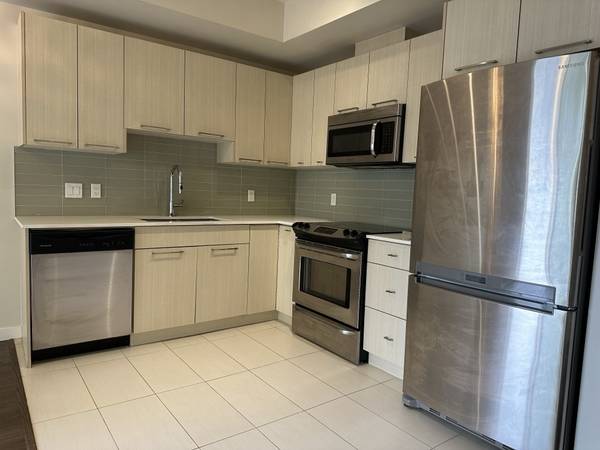
One-bedrooms within walking distance of Metrotown
29 matches as we last checked, confirmed today. This block is rebuilt from the live feed, so it is never the list that was here when the article was written.




Edmonds and 22nd Street: the cheapest platform-adjacent rent north of the Fraser
Edmonds sits in the Southeast Burnaby zone at $1,564, the lowest purpose-built one-bedroom average of any zone north of the Fraser, on a measured 24-minute ride to Waterfront with no transfer and a two-zone fare. Against a downtown baseline of $2,112 plus a one-zone pass, that is a saving of $508.50 a month for about 17.4 hours of riding — the best rent-per-commuting-hour trade in the region outside Zone 1. Eighty-eight per cent of the zone's purpose-built stock predates 1980, so expect a walk-up with heat and hot water inside the rent, coin laundry and no dishwasher, alongside a handful of newer towers at the station itself. Highgate Village handles groceries.
22nd Street is the station most people misplace. It is in New Westminster, not Burnaby — the west end of the city, on the Connaught Heights bluff — so it carries the New Westminster average of $1,645 rather than Southeast Burnaby's $1,564. It has almost nothing at street level: no mall, no high street, a park and ride and a bus loop. That is the whole trade. You are two minutes closer to downtown than Edmonds and paying $81 a month more for a location with less around it, and the neighbourhood behind it is single-family houses where most of what rents is a suite. If you want the low rent, Edmonds is the station; if you want a walkable errand, neither of these two is it.
New Westminster, Columbia, and the branch that is the long way round
New Westminster station is 29 measured minutes from Waterfront with no transfer, in a zone averaging $1,645 with 5.8% vacancy — the loosest reading on this line, though CMHC flags it as a poor-reliability estimate. Seventy-three per cent of the purpose-built stock predates 1980, concentrated Uptown around Sixth and Sixth, with a newer tower cluster on Columbia Street and at the Quay. The hill between the two is real: a ten-minute walk on the map from Columbia Street up to Sixth Avenue is a fifteen-minute climb with groceries, and no listing will mention it. Current stock is on the New Westminster page.
Columbia is the fork, and the last station before the Zone 3 boundary. Trains split there, one branch south across the Fraser to Surrey and the other north-east through Sapperton, Braid, Lougheed Town Centre and Production Way–University. Because service alternates between the two branches, headways on each are roughly half those on the trunk, which is the practical cost of living past the fork: the same two-to-five-minute peak frequency at Metrotown is four to ten at Braid. Frequency, not distance, is what makes the branch stations feel further out than the map says they are.
Sapperton is the hospital station, and the Royal Columbian expansion is the reason it has new purpose-built rental actually being delivered rather than promised. Braid is industrial and thin on amenity. Lougheed Town Centre is the one worth thinking about: it is where the Expo and Millennium lines meet, which makes it the best-connected address on the line for anyone commuting sideways to Coquitlam, Surrey or Burnaby rather than downtown. Going downtown from there, the Expo branch through New Westminster is the long way round at roughly forty minutes; the Millennium Line through Commercial–Broadway is about thirty plus a transfer. Lougheed also straddles the Burnaby–Coquitlam line at North Road, and the two CMHC averages either side of that road — North Burnaby $1,710 and Tri-Cities $1,708 — are $2 apart. The municipal boundary is invisible in the rent and visible in nothing except which city's bylaws govern your basement suite. Production Way–University is the SFU station, and the mountain is a bus ride on top of the train.
Scott Road to King George: what the river costs
The Zone 3 boundary is the Fraser crossing between Columbia and Scott Road, and it changes the arithmetic more than the housing does. A three-zone monthly pass is $54.95 a month more than a New Westminster commuter pays and $94.45 more than a Vancouver one, or $1,133 a year.
Run that against the rent and the Surrey stations stop looking cheap. Surrey averaged $1,602 on a one-bedroom; add the three-zone pass and the monthly total is $1,813.65. New Westminster at $1,645 plus a two-zone pass is $1,801.70. Surrey is $11.95 a month dearer than New Westminster once the fare is counted, and ten minutes further out. What Surrey does have is 4.3% vacancy, only 49% of its purpose-built stock built before 1980 — so in-suite laundry is common rather than a luxury — and the only place south of the Fraser where not owning a car is genuinely possible today. Whether the car comes out of the budget is the other half of that sum, and the line items are in the cost-of-living comparison.
The four stations are not interchangeable. Scott Road is a park and ride at an arterial intersection with no walkable neighbourhood attached; it exists to catch Delta and North Surrey drivers, and the CMHC Delta average is $1,550 for anyone considering the drive-and-ride. Gateway has very little around it. Surrey Central and King George are Surrey City Centre, where effectively all of the city's tower construction has gone, and where rents run above the Surrey-wide average — the price of being the only walkable, transit-served district in a city that runs twenty kilometres south to the border. Surrey neighbourhoods, compared for renters has the sub-area breakdown, and current stock is on the Surrey page.
The Canada Line, station by station
Seventeen stations, 19.2 km, opened 17 August 2009, and the only SkyTrain line in the system that is not run by BCRTC — ProTrans BC operates it, and InTransitBC holds the concession through 2040.
| Station | Municipality | Zone | CMHC survey zone | Avg. 1-bed | Source |
|---|---|---|---|---|---|
| Waterfront | Vancouver | 1 | Downtown | $2,112 | CMHC RMS, Oct 2025 |
| Vancouver City Centre | Vancouver | 1 | Downtown | $2,112 | CMHC RMS, Oct 2025 |
| Yaletown–Roundhouse | Vancouver | 1 | Downtown | $2,112 | CMHC RMS, Oct 2025 |
| Olympic Village | Vancouver | 1 | Mount Pleasant / Renfrew Hts | $1,704 | CMHC RMS, Oct 2025 |
| Broadway–City Hall | Vancouver | 1 | South Granville / Oak | $1,863 | CMHC RMS, Oct 2025 |
| King Edward | Vancouver | 1 | South Granville / Oak | $1,863 | CMHC RMS, Oct 2025 |
| Oakridge–41st Avenue | Vancouver | 1 | Westside / Kerrisdale | $1,905 | CMHC RMS, Oct 2025 |
| Langara–49th Avenue | Vancouver | 1 | Westside / Kerrisdale | $1,905 | CMHC RMS, Oct 2025 |
| Marine Drive | Vancouver | 1 | Marpole | $1,494 | CMHC RMS, Oct 2025 |
| Bridgeport | Richmond | 2 | Richmond | $1,676 | CMHC RMS, Oct 2025 |
| Capstan | Richmond | 2 | Richmond | $1,676 | CMHC RMS, Oct 2025 |
| Aberdeen | Richmond | 2 | Richmond | $1,676 | CMHC RMS, Oct 2025 |
| Lansdowne | Richmond | 2 | Richmond | $1,676 | CMHC RMS, Oct 2025 |
| Richmond–Brighouse | Richmond | 2 | Richmond | $1,676 | CMHC RMS, Oct 2025 |
| Templeton | Sea Island | 2 | — | — | no rental stock |
| Sea Island Centre | Sea Island | 2 | — | — | no rental stock |
| YVR–Airport | Sea Island | 2 | — | — | no rental stock |
Read down that column and the line does something no other line in the system does: it gets cheaper as it goes south, right up to the river, and then gets cheaper again. Marine Drive, the last Zone 1 station, sits in the cheapest survey zone in the City of Vancouver at $1,494 — below Richmond, below Metrotown, below New Westminster, below the Tri-Cities, and $618 under Downtown, while still costing a one-zone fare. Marpole is the strongest single argument on the entire network against the assumption that leaving the city saves money.
The stations above it split into three quite different markets. Olympic Village is the newest purpose-built district in the City of Vancouver, sitting in a survey zone whose average is dragged down by the Mount Pleasant walk-ups east of it — the buildings at the station rent well above $1,704, and the zone figure will mislead you here more than anywhere else on the line. Broadway–City Hall and King Edward are the Cambie corridor proper: pre-1980 low-rise on the side streets, new six-storey infill along the arterial, and a Zone 1 fare on a seven-minute ride. Oakridge–41st and Langara–49th carry the Westside/Kerrisdale average of $1,905, which is the second-dearest zone on any line and reflects a stock that is mostly older concrete and mostly not near the station.
Scheduled ride times, from TransLink's schedule effective 8 June 2026: Broadway–City Hall to Waterfront is 7 minutes, and Richmond–Brighouse to Waterfront is 27 minutes with no transfer. Every station between them is inside that 27-minute band. We do not hold sourced per-station times for the intermediate stops and are not going to estimate them; the useful figure is that the whole line, end to end, is shorter than a Coquitlam commute with the transfer counted.
The five Richmond stations all carry the same $1,676 average and are separated by what is around them rather than by price. Bridgeport is a bus exchange and a casino, and it is where the line splits. Capstan is the newest station on the network and sits in the middle of a tower district that was built before it opened. Aberdeen and Lansdowne are the malls. Richmond–Brighouse is the city centre and the terminus, which means every southbound train empties there and every northbound train fills there. Stock across all five is on the Richmond page.
The three Sea Island stations have no residential rental market and are on the page for one reason: a trip that starts at Templeton, Sea Island Centre or YVR–Airport carries a $6.50 AddFare on top of the ordinary fare. TransLink exempts certain pass products from it, so confirm the current rule against your own fare product before budgeting — at five days a week the difference is roughly $141 a month, which is more than three times the entire Zone 1 to Zone 2 pass penalty.
Two cars is the whole story on the Canada Line
The Canada Line runs 32 two-car articulated trainsets, 64 cars in all. Each set is 41 metres long and holds about 334 people in ordinary conditions. The five busiest stations have 50-metre platforms; the rest are 40 metres with room to extend to 50. Compare that with the Expo and Millennium lines, where platforms were built long enough to take four- and five-car trains, and the difference in ultimate capacity is not a detail — it is fixed in concrete along the Cambie corridor.
The second constraint is the branch. Trains split at Bridgeport, alternating between Richmond–Brighouse and YVR–Airport. TransLink's published peak frequency is six minutes to each destination, which means roughly three minutes between trains on the shared Waterfront–Bridgeport trunk and six minutes on whichever branch you live on. A renter at Aberdeen or Lansdowne is on a six-minute service in the peak, not a three-minute one, and the train arriving has already loaded at Richmond–Brighouse.
What that means at 8:15 a.m. is that the line fills from the south end and from Sea Island, and by King Edward it is a standing ride in both directions of the peak. It carried about 120,000 boardings a day in 2023. It is the busiest per-kilometre thing TransLink runs and the least able to add a car.
There is one compensation and it is real. The Canada Line has the longest service day of the three: the last weekday train to Richmond leaves at 1:15 a.m., and the weekend timetable holds close to the weekday one. The Millennium Line's last eastbound train on a Sunday leaves VCC–Clark at 12:22 a.m., and westbound service ends at 11:58 p.m. If your life includes Sunday evenings that finish late, Richmond is an hour more forgiving than Coquitlam, and nobody puts that in a listing.
One legal point belongs here rather than under each tower district, because Richmond and Marine Drive are where it bites hardest. Most of what you will be shown at Capstan, Aberdeen, Lansdowne and Richmond–Brighouse is an individually owned condominium inside a large strata. That puts it outside section 49(6.1) of the Residential Tenancy Act, which bars a personal-use eviction only where a building of five or more rental units is not strata-titled, or is strata-titled with every rental unit owned by the same owner. Ask at the viewing whether one company owns the building. Our guide to what a landlord cannot do in BC sets out where the line falls.
One-bedrooms on the Canada Line in Richmond
103 matches as we last checked, confirmed today. This block is rebuilt from the live feed, so it is never the list that was here when the article was written.


The Millennium Line, station by station
Seventeen stations, 25.5 km, VCC–Clark to Lafarge Lake–Douglas, opened 7 January 2002. Three of those stations are shared with the Expo Line: Commercial–Broadway, Production Way–University and Lougheed Town Centre. Peak frequency is 3 to 4 minutes, the best on the network.
| Station | Municipality | Zone | CMHC survey zone | Avg. 1-bed | Source |
|---|---|---|---|---|---|
| VCC–Clark | Vancouver | 1 | Mount Pleasant / Renfrew Hts | $1,704 | CMHC RMS, Oct 2025 |
| Commercial–Broadway | Vancouver | 1 | East Hastings | $1,692 | CMHC RMS, Oct 2025 |
| Renfrew | Vancouver | 1 | Mount Pleasant / Renfrew Hts | $1,704 | CMHC RMS, Oct 2025 |
| Rupert | Vancouver | 1 | Mount Pleasant / Renfrew Hts | $1,704 | CMHC RMS, Oct 2025 |
| Gilmore | Burnaby | 2 | North Burnaby | $1,710 | CMHC RMS, Oct 2025 |
| Brentwood Town Centre | Burnaby | 2 | North Burnaby | $1,710 | CMHC RMS, Oct 2025 |
| Holdom | Burnaby | 2 | North Burnaby | $1,710 | CMHC RMS, Oct 2025 |
| Sperling–Burnaby Lake | Burnaby | 2 | North Burnaby | $1,710 | CMHC RMS, Oct 2025 |
| Lake City Way | Burnaby | 2 | North Burnaby | $1,710 | CMHC RMS, Oct 2025 |
| Production Way–University | Burnaby | 2 | North Burnaby | $1,710 | CMHC RMS, Oct 2025 |
| Lougheed Town Centre | Burnaby | 2 | North Burnaby | $1,710 | CMHC RMS, Oct 2025 |
| Burquitlam | Coquitlam | 2 | Tri-Cities | $1,708 | CMHC RMS, Oct 2025 |
| Moody Centre | Port Moody | 2 | Tri-Cities | $1,708 | CMHC RMS, Oct 2025 |
| Inlet Centre | Port Moody | 2 | Tri-Cities | $1,708 | CMHC RMS, Oct 2025 |
| Coquitlam Central | Coquitlam | 2 | Tri-Cities | $1,708 | CMHC RMS, Oct 2025 |
| Lincoln | Coquitlam | 2 | Tri-Cities | $1,708 | CMHC RMS, Oct 2025 |
| Lafarge Lake–Douglas | Coquitlam | 2 | Tri-Cities | $1,708 | CMHC RMS, Oct 2025 |
Thirteen of the seventeen stations resolve to two numbers that are $2 apart. North Burnaby averaged $1,710 and the Tri-Cities $1,708. That is not a finding about the Millennium Line; it is a finding about the survey. CMHC's North Burnaby zone bundles Brentwood, Burnaby Heights, Capitol Hill, Burnaby Lake and SFU into one figure, and its Tri-Cities zone bundles three municipalities. On a line that runs from an inner-city rail yard to a lake in Coquitlam, the published rent data cannot distinguish Gilmore from Lafarge Lake, and riding the extra half hour out buys a renter approximately six dollars. The Expo and Canada lines both fall by $500 or more between their dearest and cheapest station districts. This one is flat, and a move along it should be made for the building, not the price.
What the survey can distinguish is stock age and vacancy, and those two columns do separate. North Burnaby recorded 5.6% vacancy in October 2025, which CMHC flags as a poor-reliability estimate but which is directionally the loosest sub-market north of the Fraser, driven by a wave of Brentwood and Gilmore condo completions arriving at once. Only 47% of Tri-Cities purpose-built stock predates 1980, against 78% in North Burnaby and 86 to 88% in Burnaby's southern zones. If in-suite laundry and a dishwasher are requirements rather than preferences, the Evergreen half of this line is where your search will keep landing.
The four Vancouver stations at the western end are the ones the rent table flatters least. VCC–Clark is a terminus in the False Creek Flats: a rail yard, a college campus, and a fifteen-minute walk from anything residential. Renfrew and Rupert are quiet, almost entirely single-family, and most of what rents around them is a suite in a house rather than an apartment CMHC has ever counted. They are also the last two Zone 1 stations on the line, which is their whole argument.
Gilmore and Brentwood Town Centre are the opposite: tower districts where the purpose-built rental in the survey is mostly the older walk-up stock away from the station, and the buildings at the station are stratified. That is a different building, a different landlord and a different set of protections from the glass towers at Brentwood. Holdom, Sperling–Burnaby Lake and Lake City Way are the sleepy middle of the line — industrial on one side, Burnaby Lake on the other, very little at street level, and the same $1,710 average as Brentwood two stops west. Which Burnaby town centre suits which renter is set out in the guide linked above.
Burquitlam to Lafarge Lake, and the transfer that undoes the ride
The Evergreen Extension opened on 2 December 2016 and added six stations: Burquitlam, Moody Centre, Inlet Centre, Coquitlam Central, Lincoln and Lafarge Lake–Douglas. It is the only part of the SkyTrain network built in the past fifteen years that put a rapid-transit station in front of a large stock of new-ish rental housing rather than in front of land waiting to be rezoned.
Each station has a distinct answer to "what is it actually like":
- Burquitlam is the closest to Vancouver and has absorbed most of the new tower construction. It is also the top of a hill, which matters in February.
- Moody Centre and Inlet Centre serve Suter Brook and Klahanie, with Rocky Point Park and the Murray Street brewery strip in walking distance. That is the only evening economy on this half of the line, and Port Moody rents accordingly — above the $1,708 zone average, though CMHC does not publish it separately.
- Coquitlam Central is the interchange: West Coast Express, the regional bus exchange, and park-and-ride. It is a transport node before it is a neighbourhood.
- Lincoln and Lafarge Lake–Douglas put you at Coquitlam Centre, Douglas College and Lafarge Lake, which is the most complete town centre on the line.
Now the cost that the rent table does not show. The Millennium Line does not reach downtown. Its western terminus is VCC–Clark, so every downtown trip from this line involves changing at Commercial–Broadway onto the Expo Line.
On the 8 June 2026 schedule that means roughly 36 minutes of riding from Moody Centre and 41 minutes from Coquitlam Central, before the transfer, against 9 minutes from Commercial–Broadway to Waterfront. The transfer itself is the part people underprice: it is the busiest interchange in the system, the Expo Line platform is already full at 8 a.m., and the walk between the Millennium and Expo platforms is up and over. Budget the transfer at five to ten minutes and one missed train, and a Coquitlam Central commute is a shade under an hour each way in practice.
Run that against the rent. Coquitlam at $1,708 plus the two-zone pass at $156.70 is $1,864.70 a month. Marpole at $1,494 plus the one-zone pass at $117.20 is $1,611.20, on a direct 27-minute-or-better ride and no transfer. The Evergreen Extension is a good line serving newer housing, and it is not a saving over the cheap end of the City of Vancouver. It is a saving over Downtown, Kitsilano and the North Shore, and it buys newer stock than any of them.
The SeaBus is a twelve-minute rapid transit line most renters never price
The two ends of the SeaBus are Waterfront and Lonsdale Quay, and the crossing is scheduled at 12 minutes. That is shorter than Metrotown to Waterfront on the Expo Line, shorter than Richmond–Brighouse to Waterfront on the Canada Line, and shorter than every Millennium Line station east of Renfrew. On the clock, a flat within walking distance of Lonsdale Quay has a better downtown commute than most of Burnaby.
Service, as scheduled and checked on 11 August 2026: every 10 minutes at weekday peak, every 15 minutes through the standard daytime hours, every 30 minutes late evening. Each vessel carries up to 395 passengers. The first weekday sailing leaves Waterfront at 6:01 a.m. and the last at 1:22 a.m.; Saturday starts at 6:16 a.m. and also runs to 1:22 a.m.; Sunday and holiday service starts at 8:16 a.m. and stops at 11:22 p.m. Departures from Lonsdale Quay run roughly fourteen minutes earlier than those, first sailing 5:47 a.m. on a weekday and last at 1:00 a.m. The doors inside Waterfront Station that lead to the SeaBus open ten minutes before the first sailing and close two minutes before the last, which is a detail worth knowing at 1:19 a.m.
Two things follow from that timetable that do not follow from a SkyTrain timetable. The first is that a missed departure costs 10 to 15 minutes rather than three, so the SeaBus commute has to be planned around a clock instead of walked to. The second is the Sunday 11:22 p.m. cutoff. Every other rapid service in this system runs to roughly 1 a.m. seven days a week. On a Sunday night the SeaBus stops ninety minutes earlier than the Expo Line, and the fallback is a bus over the Lions Gate or the Second Narrows, on a crossing with no schedule reliability worth the name.
Fare-wise the inlet is the zone boundary, so a weekday-daytime crossing is a two-zone trip at $4.20 on stored value. After 6:30 p.m. on a weekday and at all times on weekends and holidays it is a one-zone fare like everything else, which means the evening and weekend crossings North Shore renters actually make most often cost $2.85.
What that buys, against what it costs in rent: CMHC put the City of North Vancouver — the dense strip around Lonsdale that the SeaBus serves — at a $1,918 average one-bedroom with 2.9% vacancy, against $2,112 in Downtown Vancouver. Rent plus a two-zone pass comes to $2,074.70 against Downtown's $2,229.20. You save about $155 a month for 12 minutes each way, which is one of the two best trades in the region. Go up the hill and it reverses: North Vancouver District averaged $2,350 and West Vancouver $2,153, both above Downtown, and neither is a walk to the boat.
| Service | Scheduled crossing | Peak frequency | Last sailing, Sun/holiday | Weekday-daytime zones | Source |
|---|---|---|---|---|---|
| SeaBus, Waterfront ↔ Lonsdale Quay | 12 min | every 10 min | 11:22 p.m. | 2 | TransLink, checked 11 Aug 2026 |
One-bedrooms within reach of Lonsdale Quay
13 matches as we last checked, confirmed today. This block is rebuilt from the live feed, so it is never the list that was here when the article was written.


The West Coast Express is a bonus, never a commute
Eight stations — Waterfront, Moody Centre, Coquitlam Central, Port Coquitlam, Pitt Meadows, Maple Meadows, Port Haney, Mission City — and a timetable that disqualifies it for most people who move out there because of it.
Weekdays only. Five trains inbound in the morning, first departure 5:25 a.m. and last 7:25 a.m. Five trains outbound in the afternoon, first 3:50 p.m. and last 6:20 p.m. Nothing at midday. Nothing in the evening. Nothing on Saturday, Sunday or a statutory holiday.
Read the 6:20 p.m. departure as the operative fact. If there is any realistic chance of a late meeting, a dentist appointment, a drink after work or a shift that does not end at five, the West Coast Express is not your commute — it is a thing you take on the days it happens to work. Your actual commute is the fallback, and the fallback from Maple Ridge or Pitt Meadows is a bus to Coquitlam Central and a Millennium Line ride with a transfer at Commercial–Broadway. It is faster and more comfortable than SkyTrain from the same station, and it is useless the first time you have to stay late.
It also has its own five-zone fare structure, separate from the three-zone system every other service uses, and it is expensive.
| WCE zones | Stations | Adult one-way, stored value | Adult monthly pass | Source |
|---|---|---|---|---|
| 1–2 | Within or between adjacent zones | $5.70 | $189.85 | TransLink, 1 July 2026 |
| 3 | Moody Centre, Coquitlam Central, Port Coquitlam | $7.55 | $248.75 | TransLink, 1 July 2026 |
| 4 | Pitt Meadows, Maple Meadows, Port Haney | $9.20 | $300.20 | TransLink, 1 July 2026 |
| 5 | Mission City | $12.40 | $409.90 | TransLink, 1 July 2026 |
Set those against the ordinary pass for the same address. Port Moody sits in fare zone 2, where a monthly pass is $156.70; the West Coast Express pass covering Moody Centre is $248.75, a premium of $92.05 a month. Maple Ridge and Pitt Meadows sit in fare zone 3 at $211.65; the WCE pass covering Maple Meadows and Port Haney is $300.20, a premium of $88.55, or $1,062.60 a year. In both cases you are paying about $90 a month for access to five trains each way, on weekdays, with no evening option. The one genuine offset is that a WCE monthly pass includes unlimited travel on bus, SkyTrain and SeaBus in the same calendar month, so it is a superset of the ordinary pass rather than an addition to it.
If you hold a conventional monthly pass, a DayPass or stored value and transfer onto the train, an AddFare applies. TransLink publishes that it is charged but the fares page we checked on 11 August 2026 did not state the amount, so confirm the figure with TransLink before budgeting a mixed commute rather than trusting a number from a forum.
Mission City is the outlier at both ends. It is the only station on any of these services outside Metro Vancouver — it sits in the Fraser Valley Regional District and in the Abbotsford–Mission census metropolitan area, so it does not appear in any Vancouver CMA rent figure quoted anywhere on this page, and the $409.90 monthly pass is more than the entire rent gap between most of the zones in the region.
Maple Ridge and Pitt Meadows anchor the bottom of the CMHC rent table at a $1,426 average one-bedroom, the lowest in the region and $381 below the CMA average. That is real money, and it is the correct reason to look at Maple Ridge. The West Coast Express is not.
Students: the U-Pass deletes the fare zone from the decision
For students at the ten participating institutions — UBC, SFU, BCIT, Capilano, Langara, Douglas, Kwantlen, Emily Carr, Vancouver Community College and the Nicola Valley Institute of Technology — the entire fare-zone argument that governs every other renter's station choice stops applying.
| Period | U-Pass BC monthly rate | Source |
|---|---|---|
| 1 Sep 2025 – 31 Aug 2026 | $46.90 | TransLink, checked 11 Aug 2026 |
| 1 Sep 2026 – 31 Aug 2027 | $47.85 | TransLink, checked 11 Aug 2026 |
| 1 Sep 2027 – 31 Aug 2028 | $48.80 | TransLink, checked 11 Aug 2026 |
| 1 Sep 2028 – 31 Aug 2029 | $49.80 | TransLink, checked 11 Aug 2026 |
| 1 Sep 2029 – 31 Aug 2030 | $50.80 | TransLink, checked 11 Aug 2026 |
The fee is charged through student fees and covers bus, SeaBus and SkyTrain across all three zones. From 1 September 2026 that is $47.85 against $211.65 for an adult three-zone pass — a difference of $163.80 a month, or $1,965.60 a year, a discount of about 77% — and $69.35 a month less than an adult one-zone pass for someone living in the West End. At UBC it is billed as $191.40 for a four-month term.
The consequence for a housing search is larger than it looks, because it inverts the advice on this whole page. For a student holding U-Pass BC, the fare zone is free. There is no $39.50 penalty for crossing Boundary Road and no $94.45 penalty for crossing the Fraser. Scott Road, Surrey Central, King George, Lougheed Town Centre and Production Way–University cost exactly what Yaletown costs to reach. The only variables left are ride time, transfer count and rent, and rent falls faster with distance than ride time rises. That is why the student search and the working-adult search produce different answers from the same station map.
Five campuses sit on these lines, which is the other half of the student calculation. Langara College is at Langara–49th Avenue. SFU's Burnaby campus is up the hill from Production Way–University. Douglas College's Coquitlam campus is at Lafarge Lake–Douglas. Vancouver Community College is at VCC–Clark, and Emily Carr is a walk from it, beside the future Great Northern Way station. Vancouver General Hospital, the largest single employer on the Broadway corridor, will be at Oak–VGH.
Three limits are worth knowing before planning around it. It is a compulsory fee assessed by your student association for the terms you are enrolled in, with only a limited number of institution-specific exemptions, so it is not something you opt into for a good month and out of for a bad one. Eligibility usually turns on registration status, which means a co-op term, a term off or a part-time load can remove it and hand you a $211.65 monthly pass with no notice — budget the gap before it appears. And on the West Coast Express it buys single-ride discounts plus an all-zone U-Pass monthly WCE pass at $119.60 rather than free travel. What campus housing costs against the open market is in our off-campus housing guide, and the wider picture is in our article on student housing in Metro Vancouver.
What a station does to the building you rent
Since 30 June 2024 every SkyTrain station has a legal catchment drawn around it. Under the Housing Statutes (Transit-Oriented Areas) Amendment Act — Bill 47, which amended the Local Government Act and the Vancouver Charter — the Province designated transit-oriented areas around rapid transit stations across Metro Vancouver and beyond, each a radius measured from the station and split into tiers by distance. Around a SkyTrain station, the prescribed minimums a municipality must allow are up to 5.0 floor area ratio and 20 storeys within 200 metres, up to 4.0 and 12 storeys from 200 to 400 metres, and up to 3.0 and 8 storeys from 400 to 800 metres. The tiers are implemented through each municipality's own bylaw, so check the bylaw for the specific station rather than a general figure.
Two consequences land on a renter rather than a developer.
The first is parking. Municipalities may not require off-street residential parking in a transit-oriented area, other than accessible stalls. Builders may still provide it, and most do, but they no longer have to, and where it exists it is increasingly sold separately from the unit. So ask what the rent covers before comparing two listings: section 13 of the Residential Tenancy Act requires the written agreement to set out which services and facilities are included in the rent, and parking is one of them. If a landlord later wants to take a stall away mid-tenancy, section 27 allows it only on 30 days' written notice in the approved form and with a rent reduction equal to the reduction in the value of the agreement — and not at all where providing it was a material term of your agreement. A $150 stall dropped without a rent reduction is a claim, not a fact of life.
The second is redevelopment exposure, and it scales with proximity. The 1968 walk-up you are looking at 150 metres from Joyce–Collingwood or Edmonds sits on land the municipality must now allow to be rebuilt to twenty storeys. That does not mean it will be, and it does not change your rights, but it does mean the cheapest secure rental stock on this network is concentrated in exactly the tier where the rebuilding pressure is highest. Demolition runs on four months' notice under section 49(2) with 30 days to dispute, and the landlord must hold every permit before serving. Renovation is stricter again: since 2024 the landlord must first obtain an order from the Residential Tenancy Branch under section 49.2. Our eviction notice guide sets out what a valid notice has to contain. The point here is narrower: the answer to "how close to the station?" has a demolition column in it as well as a walking-time column.
One-bedrooms near a Burnaby station
110 matches as we last checked, confirmed today. This block is rebuilt from the live feed, so it is never the list that was here when the article was written.


What the Broadway Subway does to a Millennium Line address
The Millennium Line Broadway Extension is 5.7 km, all but 700 metres of it underground, at a stated cost of $2.83 billion. It runs west from VCC–Clark through six new stations: Great Northern Way–Emily Carr, Mount Pleasant, Broadway–City Hall, Oak–VGH, South Granville and Arbutus. Two tunnel boring machines, each six metres in diameter, worked 15 to 20 metres below Broadway. The Province's stated opening is late 2027. The date has moved before — 2025, then 2026 — so treat it as a plan rather than a fact, and do not sign a lease on the strength of it.
Three consequences matter to a renter choosing a station today.
Broadway–City Hall becomes an interchange. Today it is a Canada Line station. From opening it is the crossing point of the two lines, which gives every Millennium Line rider from Gilmore to Lafarge Lake a second route downtown — west along Broadway, then north on the Canada Line — instead of the single choke point at Commercial–Broadway. That is the largest improvement the Evergreen half of the line has had since it opened, and it accrues to Zone 2 addresses. It is also the single biggest change to this network's shape since 2016.
Arbutus is the end of the line, and it is an interim terminus. Everything west of Arbutus — Kits Point, West Point Grey, 4th Avenue past Macdonald, the campus itself — stays bus territory for the life of any lease you sign now. TransLink has said B-Line service continues between Arbutus and UBC both before and after the subway opens, so a Kitsilano address is a bus address in 2027 exactly as it is today.
The rectangle above the tunnel is the Broadway Plan area, and the older purpose-built walk-ups in it are the cheapest secure rental stock on the west side. If you are viewing a 1960s three-storey between Vine and Clark, between 1st and 16th, the redevelopment question set out in the previous section belongs in the same conversation as the rent. Construction is also a live amenity cost rather than an abstraction: the corridor between Great Northern Way and Arbutus has been a worksite for years, with long arterial closures at the station boxes.
What opens next, and why the premium does not arrive with the announcement
| Project | What it is | Status as of 11 August 2026 |
|---|---|---|
| Broadway Subway | 5.7 km Millennium Line extension, VCC–Clark to an interim terminus at Arbutus, six underground stations, interchange with the Canada Line at Broadway–City Hall | Under construction; stated opening late 2027 |
| Surrey Langley SkyTrain | 16 km elevated Expo Line extension, primarily along Fraser Highway from King George Station to 203 Street in Langley City, eight stations | Under construction; anticipated in service late 2029 |
| Millennium Line UBC Extension | Arbutus to the UBC campus | Not funded, not under construction, no opening date published |
Sources: Broadway Subway Project and Surrey Langley SkyTrain, Province of British Columbia, checked 11 August 2026.
The eight Surrey and Langley stations are Green Timbers, 152 Street, Fleetwood, Bakerview–166 Street, Hillcrest–184 Street, Clayton, Willowbrook and Langley City Centre. Construction is underway along the corridor. Langley's one-bedroom average is already $1,765 — dearer than Surrey, New Westminster, Richmond and Southeast Burnaby — and the transit trip from Langley City to downtown today is 104 minutes. That is at least three lease cycles away from being a SkyTrain commute, and rapid transit projects in this region have slipped before. Do not sign for a Fraser Highway address on the strength of a station that is a construction hoarding.
The rule that follows is asymmetric and worth stating plainly. Rents near a station under construction rise on the strength of the station; the station does not carry passengers for another one to three years; and a lease is twelve months. Pay for the transit you can board this week.
But the mirror of that is a genuine argument for signing early and staying. BC caps the annual increase inside a tenancy — 2.3% for 2026 — and caps nothing at all when a unit turns over. A tenancy signed in Fleetwood or Clayton in 2026 and held through 2030 carries the pre-station rent forward under the cap, and the station premium lands on whoever signs after you leave. If the line opens during your tenancy, the improvement arrives free. That only works if the commute is tolerable in the meantime, and if you can live beside four years of guideway construction.
How to read "steps to SkyTrain"
Eight hundred metres is the planning definition of a station area and about a ten-minute walk on flat ground with no obstacles. Listings measure in straight lines and rarely mention the obstacles.
Walk it, at the hour you would walk it. Ten minutes on a map across Kingsway, Lougheed Highway, No. 3 Road or Fraser Highway with one signalised crossing is not ten minutes. Neither is a route that ends with a climb, which is most of New Westminster and all of the North Shore.
Ask which way the unit faces. The Expo and Millennium lines are elevated for nearly their whole length, and a unit facing the guideway within about fifty metres hears a train every three to five minutes at peak, from roughly 5 a.m. until roughly 1 a.m. The trains are quieter than they were — Mark V rolling stock entered service in July 2025 — but a flat whose bedroom window faces a guideway forty metres away is a different flat from one on the other side of the same building at the same rent. The Canada Line is in a bored tunnel through Cambie and elevated through Richmond, so the exposure there depends entirely on which half of the line you are looking at, and the Broadway Subway stations will be underground. View both sides of the building, ask which floor, view with the window open, and go back once in the evening — a viewing at 2 p.m. on a Tuesday tells you nothing about a train every three minutes at 7:45 a.m.
Check whether a bus exchange is attached. At Metrotown, Brentwood, Lougheed, Coquitlam Central, Surrey Central and Bridgeport the bus loop is louder and closer than the trains, it runs earlier and later, and it is not what anyone pictures when they read "steps to SkyTrain."
Find the last train for your station, not for the system. Service winds down somewhere around 1 a.m., but the Canada Line runs later than the Millennium Line on a Sunday, and the last eastbound and last westbound trains from your own station are not the same time. Look up the specific pair before you sign.
Ask what is included and what heats the place. The written agreement has to say, under the section quoted above, so the answer belongs on paper rather than in a conversation. A station-adjacent 2019 tower with a $150 parking stall and metered electric heat is not the same monthly cost as a 1972 walk-up two stops further out with heat and hot water in the rent, whatever the two posted rents say.
What the station column is actually worth
Put the whole page back together and the ranking is not the one the map suggests.
The fare-zone premium between Zone 1 and Zone 3 is $94.45 a month on a monthly pass — $1,133 a year — and it evaporates for students, for concession riders, for anyone working locally by bus, for anyone in the office three days a week, and for anyone whose trips are mostly after 6:30 p.m. or at weekends. The rent spread across the region is $1,043 a month on a one-bedroom, and the spread inside a single fare zone is wider than the fare spread across all three: Marine Drive at $1,494 and Waterfront at $2,112 are both Zone 1, three stops and $618 apart. Fare zone is the smallest of the three numbers on the table. It is simply the one that is easiest to look up.
What does move the answer is being on a line at all, and being on it without a transfer. A one-seat ride from Edmonds, Metrotown, New Westminster, Marine Drive or Richmond–Brighouse beats a shorter ride that ends with a change at Commercial–Broadway at 8:15 a.m., and it will keep beating it until the Broadway Subway opens. Frequency beats proximity too: a twelve-minute boat every ten minutes is a better commute than an eight-minute walk to a station on a branch you have to wait for.
Three questions settle a station, in this order. How many days a month do you actually make this trip, because that decides whether the fare is $211.65 or $140. Is it one seat or two, because a transfer costs more minutes than three stops. And what does the last train do on a Sunday, because that is the constraint you will meet on the worst night rather than the average one.
Everything above reflects TransLink fares effective 1 July 2026, TransLink schedules and service information checked on 11 August 2026, and CMHC's Rental Market Survey for October 2025 published 11 December 2025. Fares move on 1 July most years and the U-Pass rate moves on 1 September, so check both against a current page before committing a figure to a budget. Nothing here is legal advice; the Residential Tenancy Branch takes calls at 1-800-665-8779, the region's areas are compared on rent, stock and commute in where to rent in Metro Vancouver, and the rest of our tenant guides cover the parts of a BC tenancy this page leaves alone.
Keep reading
The rest of what we have written about renting here.
Renting in Vancouver
3 Bedroom Rent in Vancouver: What Families Pay and What They Are Owed
Metro Vancouver holds 5,658 purpose-built rentals with three bedrooms or more. What the space costs, what childcare adds, and what a landlord may never ask.
Renting in Vancouver
Student Housing in Metro Vancouver: Beds, Rents and Rights
UBC holds 13,883 student beds; every other campus here has a fraction of that. What residence costs, what renting costs, and which rules cover you.
Renting in Vancouver
Types of Rental Housing in Metro Vancouver: A Renter's Map
Purpose-built, condo, suite, co-op, non-profit, pad or residence. Which of Metro Vancouver's rental types you sign for decides which law protects you.
Tenancy law
The Residential Tenancy Branch: What It Does and How Long It Takes
What the B.C. Residential Tenancy Branch can order, what the $100 filing fee buys, who gets it waived, and how long you actually wait for a hearing.
Tenancy law
Roommates in BC: Co-Tenant, Occupant, and Who Pays When One Leaves
Your name on the tenancy agreement decides everything: joint liability for rent, what happens when a roommate gives notice, and what an agreement can do.
Tenancy law
Subletting and Assignment in BC: What Section 34 Requires
A sublet keeps your tenancy, an assignment ends it. Section 34 rules on written consent, unreasonable refusal, liability and sublet scams in BC.